

Overview
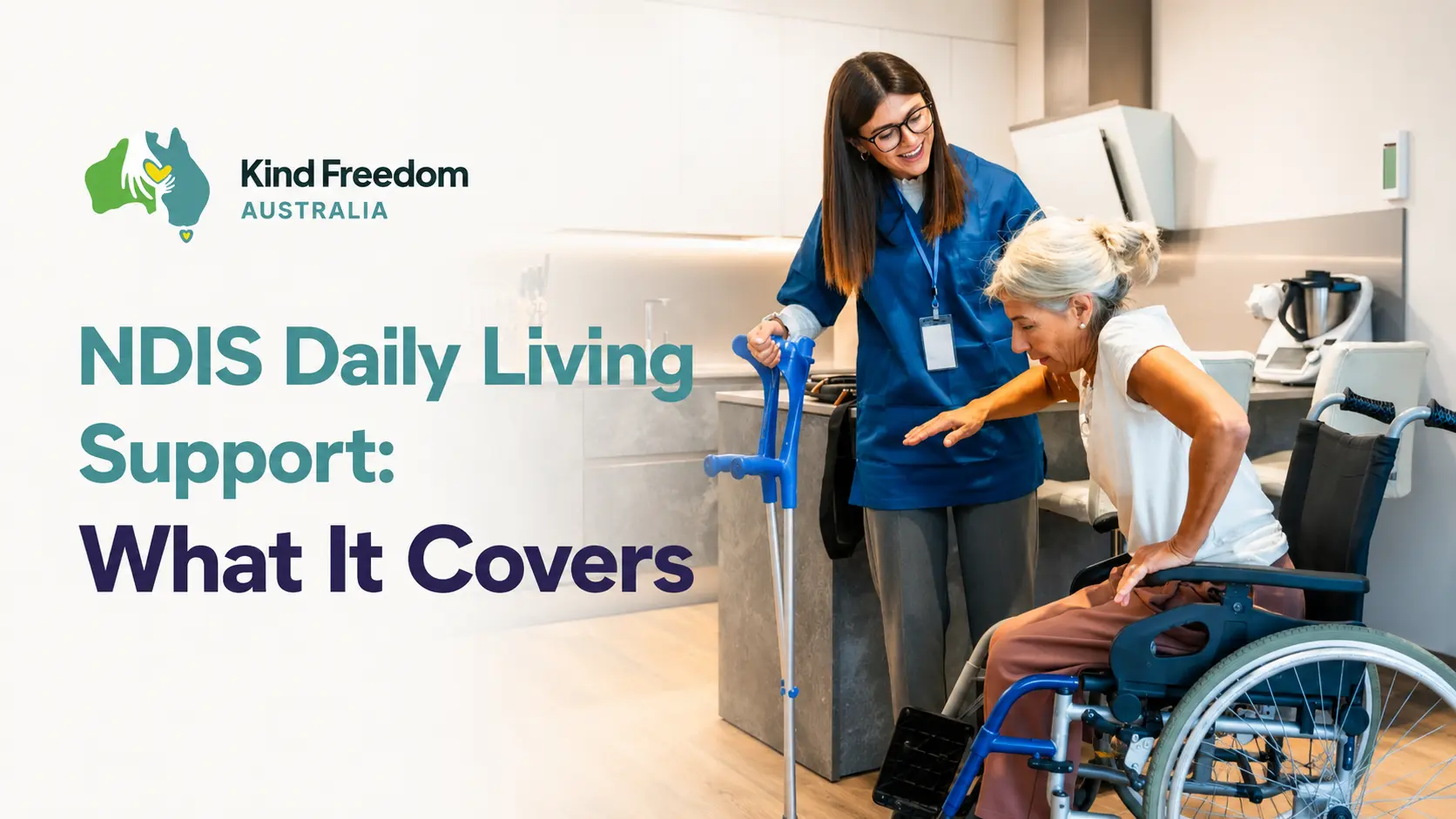
NDIS Daily Living Support helps participants manage essential everyday tasks such as personal care, household chores, meal preparation, and staying safe at home. Understanding what this funding covers and what it doesn't can help you make better use of your NDIS plan. In this guide, you'll learn what's included, who is eligible, how funding works, and how to access the right support in Melbourne.
Table of contents
(11 sections)
Table of contents
(11 sections)A lot of NDIS participants find out about daily living support by accident. A support coordinator mentions it in passing. A family member comes across it in an online forum. Or it comes up at a plan review and nobody is quite certain what it has been covering all along.
It's one of the most commonly misunderstood parts of the NDIS not because it's complicated, but because the official name, Assistance with Daily Life, doesn't immediately tell you what it actually funds. Showering, cooking, cleaning, getting dressed are the things we're talking about. And for many participants, having the right support with these fundamentals is what makes everything else possible.
This guide explains exactly what NDIS daily living support covers, what falls outside it, who qualifies, and how to access it in Melbourne.
What Is NDIS Daily Living Support?
NDIS daily living support officially called Assistance with Daily Life is a Core Support funded under Category 1 of your NDIS plan. It covers the practical, hands-on support that helps a person with disability manage personal care, household tasks, and daily routines that their disability makes difficult or impossible to do safely and independently. It can be delivered in your home, in the community, or alongside other support in the same session.
This is typically one of the largest allocations in a plan for participants with physical disability or neurological conditions and for good reason. Without it, everything else in the plan is harder to reach.
What Does NDIS Daily Living Support Cover?
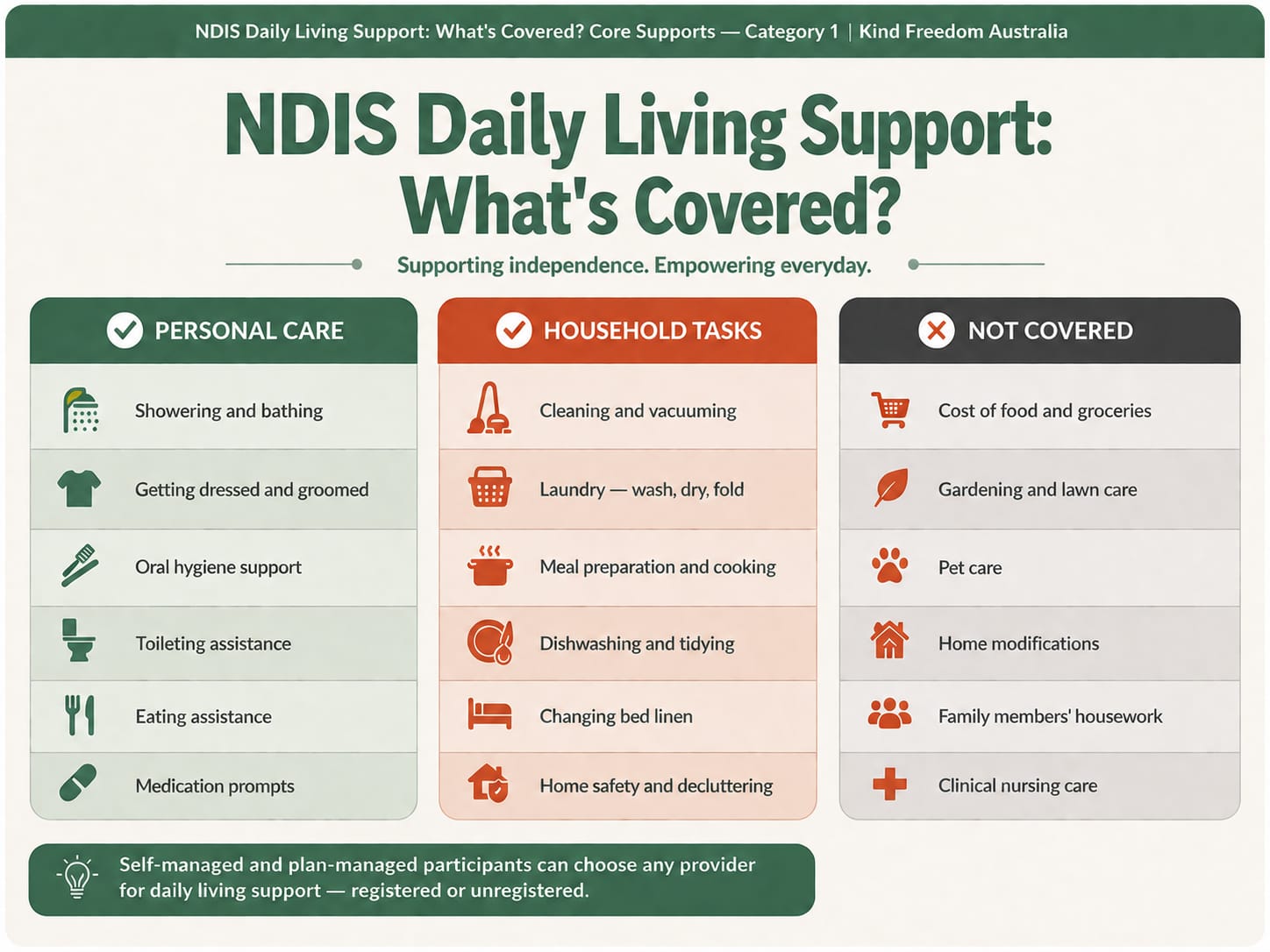
Daily living support funds two main types of hands-on assistance: personal care and household tasks. Here is what each includes in practice.
Personal Care Support
Personal care is the most common form of daily living support. It covers help with self-care tasks where your disability directly affects your ability to manage independently. Kind Freedom's Low-Risk Personal Care service includes:
Showering and bathing, including washing hair
Getting dressed and undressed
Grooming shaving, skincare, oral hygiene
Toileting and continence care
Eating assistance, where your disability affects your ability to eat safely
Medication prompts (not administration that is a clinical nursing function)
Safe transfers and positioning, where prescribed by a physiotherapist or OT
The goal of personal care is not to take over. It's to provide the right level of support for the tasks where you genuinely need it, while building on what you can do independently. A good support worker reads the difference every session.
Household Tasks Support
Daily living support can also fund help with household tasks that your disability makes difficult or unsafe:
Cleaning and vacuuming
Laundry washing, drying, folding, putting away
Dishwashing and tidying the kitchen
Meal preparation and cooking, including adapting for dietary needs
Changing bed linen
Accompanying you to the supermarket and assisting with grocery shopping
Light yard work and maintaining a safe outdoor environment
Basic home organisation where mobility or fatigue is a factor
These tasks are funded because your disability affects your capacity to manage them not simply because they are difficult or time-consuming. It is worth noting that NDIS funds the support worker's time to assist with grocery shopping not the cost of the groceries themselves. Your everyday living costs remain your own responsibility.
Home Safety Support
Participants with mobility challenges, fall risk, or progressive neurological conditions can also access support with managing everyday safety in the home:
Removing trip hazards and managing clutter in movement paths
Assisting with safe movement around the home during daily routines
Supporting the use of mobility aids walkers, wheelchairs, hoists within the home environment
Monitoring and noting any changes in functional capacity that should be reported to a treating clinician
This type of support is particularly relevant for participants living with multiple sclerosis (MS), Parkinson's disease, acquired brain injury (ABI), or post-stroke conditions where the home environment itself can become a significant risk factor.
Overnight and 24-Hour Support
If your care needs extend into the night, daily living support can also fund:
Sleepover support — a support worker is present and available overnight if needed
Active overnight support — hands-on support is provided during overnight hours
24-hour care — for participants with complex needs requiring continuous support
The level of overnight funding in your plan reflects your assessed needs and the risk level if support is not available.
💡 Pro Tip: If you're living with a condition that changes day to day MS, Parkinson's, or ABI it's worth making sure your plan notes that variability explicitly. Plans built around your "best day" often underestimate your actual support needs. Your assessor needs to understand what a difficult morning looks like, not just a good one.
What Isn't Covered by NDIS Daily Living Support
Understanding what falls outside this support is just as important as knowing what's included. The NDIS funds the assistance with daily tasks not the costs of daily living generally.
Not Covered | Why |
The cost of food and groceries | NDIS funds the support worker's time to assist with shopping and meal preparation, not the cost of the food itself |
Heavy landscaping or ongoing garden maintenance | Light yard work is covered; major landscaping and ongoing garden upkeep fall outside NDIS daily living support |
Pet care | Not considered a daily living support under NDIS guidelines |
Home modifications | Funded under Capital Supports a separate budget category entirely |
Support for family members or other household members | NDIS funds the participant's support, not general household management for others |
Cleaning shared areas the participant doesn't use | Must connect directly to the participant's disability and living needs |
Clinical nursing care | Wound care, IV medication, catheter management outside NDIS daily living scope |
Before your first session, sit down with your support worker and map out exactly which tasks you need help with and how much assistance each one requires. This shapes the support plan and helps you get the most value from every hour. Your plan manager can clarify what specific tasks are covered under your plan's daily living funding.
Who Is Eligible for NDIS Daily Living Support?
Not every NDIS participant automatically receives daily living support funding. The NDIS assesses it as "reasonable and necessary" based on several factors.
Your disability must directly affect your ability to manage daily tasks
A physical disability, neurological condition, cognitive impairment, or mental health condition that impacts self-care or household management is typically what qualifies you. The connection between the disability and the task difficulty must be clear.
Your informal support is considered
The NDIS will look at what support you already receive from family or carers. If a family member provides significant daily care, that will factor into the funding assessment. If that care arrangement creates a real career burden, include that context in your planning conversation; it is relevant to how your plan is built.
It must connect to your plan goals
Your goals don't need to be elaborate. Something as clear as "to maintain my daily hygiene routine safely with support" or "to live independently in my own home with assistance" is sufficient to justify daily living funding.
Self-managed and plan-managed participants have the most flexibility
You can choose any provider registered or unregistered to deliver your daily living support. NDIA-managed participants are limited to registered providers only.
How Is NDIS Daily Living Support Funded?
Daily living support is funded from your Core Supports budget, the most flexible part of your NDIS plan. Core Support funding can generally be moved between its sub-categories (daily activities, community participation, consumables, and transport) as your needs shift across the year.
This flexibility matters. If your daily living support needs increase after a hospital stay, a change in your condition, or a period where your usual carer is unavailable you may be able to draw on other Core funding rather than waiting for a formal plan review.
Speak with your plan manager about how to use your Core budget flexibly if your circumstances change.
Finding Daily Living Support in Melbourne
If you're in Melbourne, your options for daily living support vary depending on where you live, your disability, and whether your plan is self-managed or plan-managed.
Self-managed and plan-managed participants can engage any provider registered or unregistered which gives you the freedom to choose based on fit, expertise, and consistency rather than just availability.
When assessing a provider for daily living support, it's worth asking:
Will I have the same support worker every visit, or will it be different people each time?
Does the worker understand my specific disability or condition?
Can daily living sessions incorporate therapy exercises if my physiotherapist or OT has prescribed a home program?
What's the cancellation policy, and how much notice do I need to give?
The last question matters more than it might seem. A provider whose clinical background allows them to incorporate your therapy program into a daily living session gives you twice the value from the same funded hour.
Kind Freedom provides daily living assistance for self-managed and plan-managed participants across Melbourne including the western suburbs (Sunshine, St Albans, Footscray, Werribee, Caroline Springs, Tarneit, Melton, Point Cook), northern suburbs (Craigieburn, Broadmeadows, Essendon, Reservoir), and inner Melbourne. We hold a Certificate IV in Allied Health Assistance, which means your daily living sessions can incorporate prescribed therapy exercises alongside personal care and household support.
Choosing the Right Daily Living Support Provider
Daily living support is not just about completing tasks. For many people with disabilities, it is what allows them to stay in their own home, maintain personal dignity, manage fatigue effectively, and have the energy to pursue the goals that matter most.
If you are not sure whether daily living support is in your current plan or whether you are using it effectively it is worth reviewing what you are funded for before your next planning meeting.
Not sure if Kind Freedom is the right fit? Have a straight conversation with us. We'll tell you honestly whether our service matches what you need. No commitment, no forms just a direct conversation.
For more on the full range of NDIS services available in Melbourne, or what to ask before choosing an NDIS provider, see our related guides.
Written by
Edson Rushenya
Kind Freedom Australia blogger.