

Overview
NDIS life skills support helps participants build the confidence and practical skills needed to live more independently. From cooking and budgeting to travel training and daily routines, this Capacity Building support focuses on developing abilities rather than simply providing assistance. In this guide, you'll learn what NDIS life skills support covers, who can access it, how it's funded, and how it can help you achieve greater independence.
Table of contents
(14 sections)
Table of contents
(14 sections)There are two very different ways an NDIS plan can help someone who finds it hard to cook a meal. One approach sends a support worker to cook for them. The other builds the skills so they can cook for themselves.
Both are valid. Both exist within the NDIS. But they sit in completely different parts of your plan and only one of them changes what is possible next year, and the year after that.
Life skills support is the part of the NDIS that most participants never fully understand. Many assume their plan is already covering it. Some have never had it explained in plain terms. Others have genuine capacity building goals sitting in their plan that have not translated into any actual sessions.
This is what NDIS life skills support is, what it covers, and how to make sure you are actually using it.
What Is NDIS Life Skills Support?
NDIS life skills support formally called Capacity Building – Daily Activity is funded under Category 9 of your NDIS plan. It covers structured coaching, training, and skill development that helps a person with disability build independence in everyday life. This includes things like cooking, managing money, using public transport, maintaining a home routine, and navigating community services.
Unlike daily living support (which funds a support worker to assist you with tasks), life skills support funds the process of learning to manage those tasks more independently at whatever level your disability and goals allow. The goal is building capacity, not maintaining dependence.
Life Skills vs Daily Living Support: What Is the Difference?
This is the question that causes more confusion than almost any other in the NDIS.
NDIS daily living support , Category 1, Core Supports, funds a support worker to help you with personal care and household tasks directly. If you need someone to assist with showering, cleaning, or meal preparation because your disability means you cannot do these safely or independently, that is daily living support.
Life skills support, Category 9, Capacity Building, funds the coaching and training to build your ability to do those tasks with greater independence over time. A support worker does not do the task for you. They work alongside you, coach you through the steps, repeat sessions consistently, and help you build the confidence and skill to do more on your own.
In practice, both often appear in the same plan. A participant might receive daily living support in the morning for high-support personal care needs, and use life skills sessions through the week to build toward greater independence in the kitchen or with managing a budget.
They serve different purposes and come from different parts of your plan budget. Understanding which applies to your situation and whether you have both is worth knowing before your next plan review.
Daily Living Support | Life Skills Support |
Provides hands-on assistance with daily tasks | Teaches you how to complete daily tasks independently |
Focuses on meeting your current support needs | Focuses on building long-term independence |
Funded through Core Supports (Category 1) | Funded through Capacity Building (Category 9) |
Support worker completes or assists with the task | Support worker coaches and guides you through the task |
What Does NDIS Life Skills Support Cover?
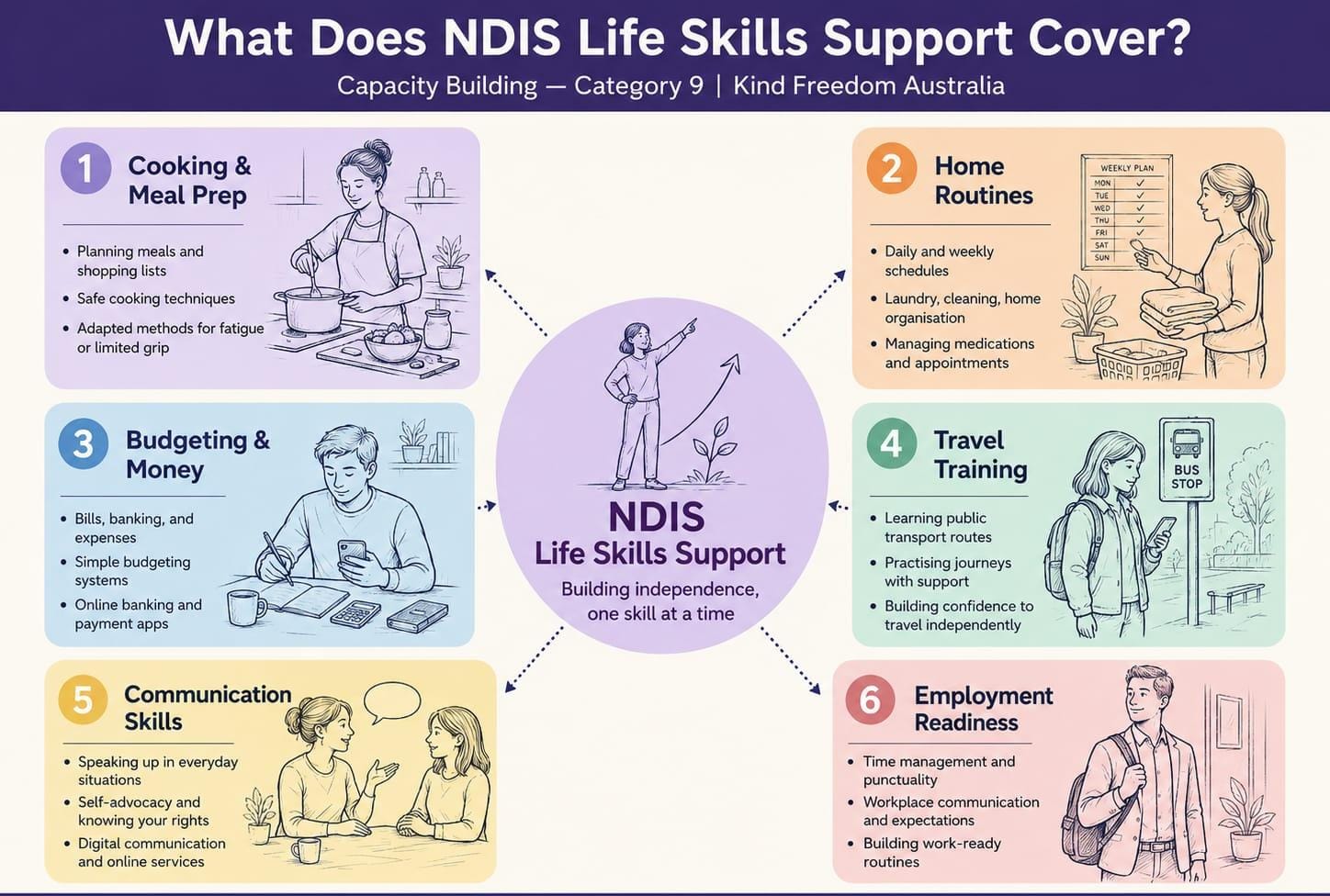
Life skills support is broader than most participants realise. It is not limited to cooking and cleaning. Here is what it covers across six practical areas.
Cooking and Meal Preparation
Learning to plan, prepare, and cook meals safely and with growing independence. This is one of the most common life skills goals for participants living alone or working toward greater independence. Sessions may cover:
Meal planning and writing shopping lists
Safe kitchen practices heat, knives, food hygiene, and storage
Simple recipes adapted for dietary needs or physical limitations
Adapting techniques for fatigue, limited grip, or single-handed preparation
Using kitchen aids and adaptive equipment confidently
For participants with conditions that affect concentration or task sequencing such as acquired brain injury or post-stroke recovery this often involves breaking meal preparation into very small, repeatable steps before gradually building up to a full routine.
Household Management and Home Routines
Building consistent daily and weekly routines for managing a home independently:
Developing personal schedules and daily structure
Laundry, cleaning, and home organisation
Managing medications, appointments, and household paperwork
Using phone reminders, apps, or visual schedules to stay on track
Managing fatigue across the day to preserve energy for priority tasks
For participants with neurological conditions, the ability to maintain home routines often fluctuates. Life skills sessions can help build strategies that work even on lower-capacity days not just when everything is going well.
Budgeting and Financial Management
Understanding how to manage money independently one of the highest-impact life skills for participants moving toward or maintaining independent living:
Understanding bills, bank accounts, and regular household expenses
Setting up simple, sustainable budgeting systems
Shopping within a budget and comparing costs
Understanding your NDIS plan budget and how to track spending
Digital skills for online banking, apps, and payment platforms
The NDIS funds this support because financial difficulty is a direct consequence of disability for many participants not a lifestyle choice. Coaching in this area builds long-term independence.
Travel Training and Getting Around Independently
Learning to navigate public transport and move around the community independently, where this is a realistic and meaningful goal:
Understanding timetables, routes, and connections
Practising specific journeys until they become manageable
Using apps for navigation and real-time transport information
Managing unpredictable changes such as delays, route cancellations, or unfamiliar stations
Building confidence to travel alone to familiar destinations before expanding to new ones
Travel training can significantly expand what a participant can access independently reducing reliance on transport support and opening up community participation and employment options.
Communication and Social Skills
Developing communication skills that support greater participation in everyday life:
Communicating needs clearly in everyday situations shops, appointments, services
Understanding social expectations in different environments
Assertiveness and self-advocacy knowing your rights and how to speak up
Digital communication email, messaging, online services
Practising real-world interactions in supported settings before doing them independently
For participants with cognitive or communication-affecting conditions, this area directly supports independence across every other life domain.
Employment Readiness and Workplace Preparation
Where employment is a goal in a participant's plan, life skills support can fund foundational preparation:
Time management and punctuality strategies
Workplace communication and professional behaviour expectations
Practical readiness, presentation, getting to work independently, managing a work schedule
Understanding workplace rights and reasonable adjustments for disability
Building work-related routines in the lead-up to entering or returning to employment
This is distinct from formal employment support programs. It covers the foundational life skills that sit underneath a person's readiness to take the next step toward work.
What Isn't Covered by NDIS Life Skills Support?
Not Covered | Why |
Tasks done for the participant without a skill-building focus | Support without a capacity-building goal belongs in daily living (Category 1), not life skills |
Formal academic study or university courses | Education funding sits under a separate NDIS category |
Therapy provided by a registered allied health clinician | Therapy is funded under Capacity Building – Improved Health and Wellbeing (Category 11) |
Support coordination | A separate budget category — Category 7 |
Employment placement, job coaching, or formal DES programs | Covered under Capacity Building – Finding and Keeping a Job (Category 10) |
General companionship without a skills development goal | Must be connected to a specific capacity building outcome in the participant's plan |
💡 Pro Tip: Life skills sessions work best when they are linked to specific, measurable goals in your NDIS plan. If your plan says "develop independent living skills" but does not say what that means in practice, work with your support worker and plan manager to translate it into concrete session goals for example, "prepare three different meals independently within 12 weeks." Specific goals create a clear record of progress, which strengthens your case at plan review.
How Is Life Skills Support Funded Under the NDIS?
Life skills support is funded from your Capacity Building budget specifically Category 9 (Improved Daily Living Skills). This is an entirely separate budget from your Core Supports.
There is an important distinction here. Capacity Building funding is generally not flexible between sub-categories the way Core Supports funding can be. Your life skills budget sits in Category 9 and is allocated for that purpose. It cannot be redirected to daily living support, community participation, or another category.
This means that if you have Category 9 funding in your plan and are not using it, it does not roll across to another area; it simply goes unspent at the end of your plan period.
Self-managed and plan-managed participants can engage any provider registered or unregistered for life skills support. NDIA-managed participants are limited to registered providers only.
For a broader overview of how NDIS supports work across Melbourne, see our guide to NDIS services in Melbourne.
Who Can Access NDIS Life Skills Support?
Life skills support is not automatically included in every NDIS plan. The NDIS funds it where it is reasonable and necessary meaning it must connect to your disability and your goals, not simply to a general desire to learn new skills.
You are likely to qualify where:
Your disability directly affects your ability to manage daily life tasks independently
You have goals in your plan that relate to greater independence, employment, or community participation
You are in a transition period moving out of home, leaving school, or shifting from high-level support toward more independent living
You are recovering from an acquired condition such as stroke, brain injury, or a significant neurological change, and working to rebuild functional capacity
Your condition creates fluctuating capacity, and building better strategies and routines would meaningfully reduce your overall support needs over time
If you have life skills goals that are not currently reflected in your plan, raise them specifically and clearly at your next planning conversation. Goals need to be stated in your plan for Category 9 funding to be allocated.
💡Important:If you are approaching a plan review and want life skills support included or increased, bring evidence. A letter from your occupational therapist or physiotherapist noting your independence goals, or a written progress summary from your current provider, gives the planner something concrete to assess. The NDIS needs to see that the support connects to your disability and is genuinely building your capacity not simply happening in the background.
How Kind Freedom Supports Life Skills Development
Life skills coaching is not one-size-fits-all and for participants with physical or neurological conditions, the approach needs to account for how the condition actually behaves day to day.
Fatigue affects when skills can be practised and how long sessions can run effectively. Cognitive sequencing difficulties affect how tasks need to be broken down and how quickly the next step should be introduced. Good days and harder days are part of the reality of living with MS, acquired brain injury, Parkinson's disease, or post-stroke recovery and a life skills programme that only works on good days is not really building independence.
As a Certificate IV Allied Health Assistant, Edson designs life skills sessions around each participant's realistic capacity — not their best-case day. Where an occupational therapist or physiotherapist has prescribed goals that overlap with daily life skills (home exercise programmes, transfer strategies, home management tasks), sessions can incorporate those goals alongside life skills coaching, making the most of every funded hour.
Kind Freedom's Life Skills & Independence service supports self-managed and plan-managed participants across Melbourne's western suburbs (Sunshine, St Albans, Footscray, Werribee, Caroline Springs, Tarneit, Melton, Point Cook), northern suburbs, inner Melbourne, and south-east. We work with participants across a wide range of conditions and independence goals from building basic home routines through to preparing for independent living transitions or returning to employment.
We do not work with NDIA-managed participants.
For more on how life skills goals connect with community participation funding, see our guide to NDIS community participation.
Ready to Build Your Independence?
Life skills support exists in the NDIS because independence matters not just practically, but for confidence, wellbeing, and long-term quality of life. A plan that only maintains your current support level is not the same as a plan that is actively building toward something.
If you have Category 9 funding in your plan and are not sure what to do with it or if you suspect your plan should include life skills support but it has never been discussed a direct conversation is the best place to start.
Reach out to Kind Freedom, we will have an honest conversation about your goals and whether our approach is the right fit. No commitment, no waiting list.
For more on the full range of NDIS services available in Melbourne, see our related guides.
Written by
Edson Rushenya
Kind Freedom Australia blogger.