

Overview
NDIS community participation helps people with disability take part in everyday social, recreational, educational, and community activities. This guide explains what community participation covers, what it doesn't fund, how it fits into your NDIS plan, and how participants across Melbourne can access the right support.
Table of contents
(13 sections)
Table of contents
(13 sections)There is a version of community participation support that looks like someone being driven to an event and sitting near a wall while time passes. The person is technically present. The box is technically ticked. But that is not participation, it is transportation with company.
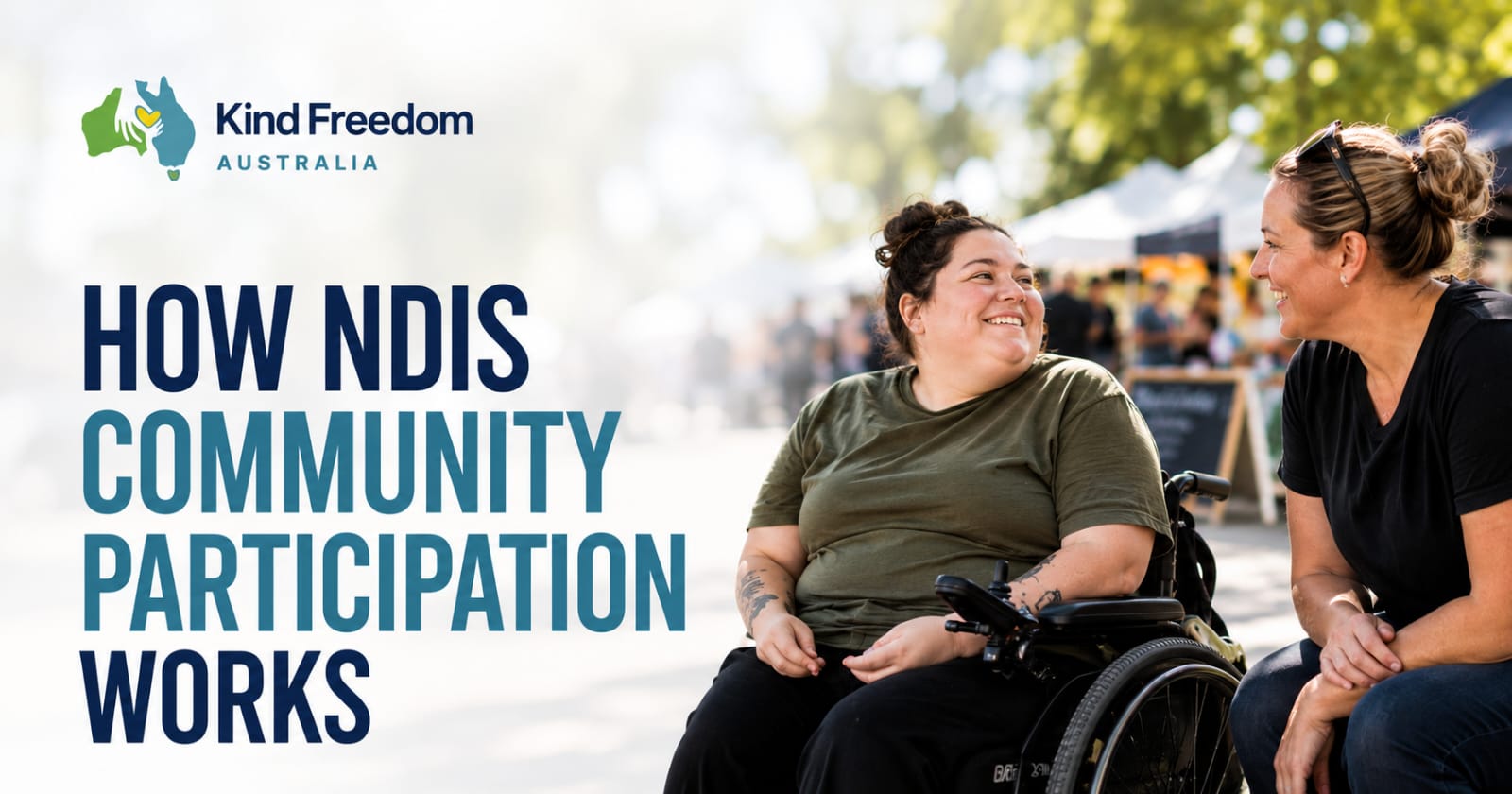
Real community participation means being genuinely involved in something that matters to you. Attending a sport you enjoy, joining a group, taking a class, volunteering, going to the gym, getting to events and actually being part of them. The NDIS funds the support that makes this possible and for participants with physical disability or neurological conditions, having the right person alongside can be the difference between going and genuinely thriving.
What Is NDIS Community Participation?
NDIS community participation officially called Assistance with Social, Economic and Community Participation is a Core Support funded under Category 4 of your NDIS plan. It covers support that helps a person with disability access social activities, recreation, community groups, volunteering, education, and public life. The support focuses on genuine inclusion and participation, not just physical attendance.
This funding is separate from your daily living budget. It is specifically designed to help participants engage with the world beyond their home on their terms, at their pace, doing things that genuinely matter to them.
What Activities Does NDIS Community Participation Cover?
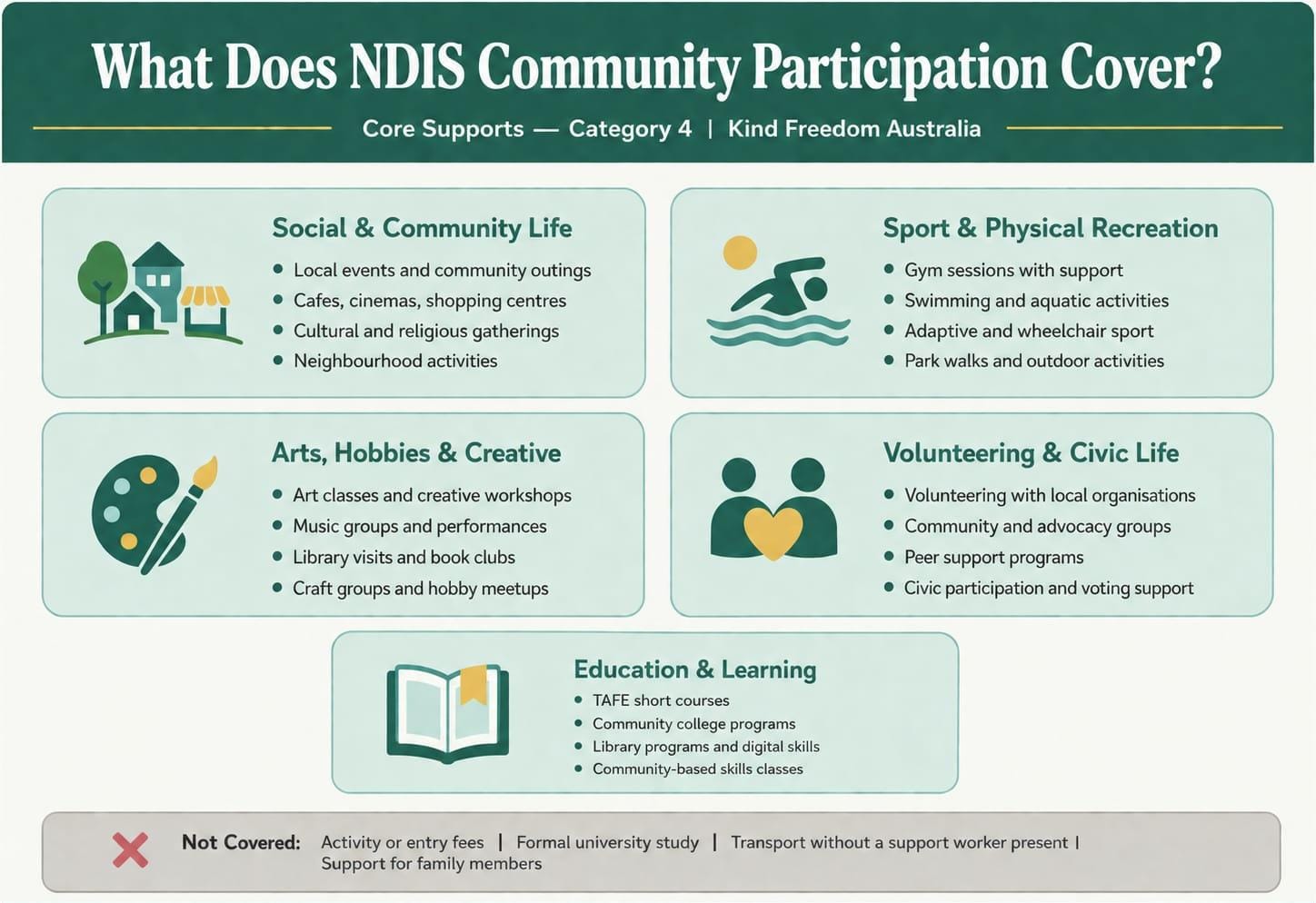
Community participation support is broader than most people realise. It is not limited to organised social groups or formal programs. Here is what it covers across five activity areas.
Social Activities and Community Life
Support to attend and participate in social events, outings, and everyday community activities things most people without disability do without needing to plan around access, fatigue, or physical support:
Attending local events, festivals, markets, and cultural activities
Social outings with friends or family where disability-related support is needed
Shopping centres, cafes, cinemas, and community venues
Religious or spiritual services and community gatherings
Neighbourhood activities and local council programs
Sport and Physical Recreation
For many participants with physical disability, sport and recreation require support to access safely and enjoyably. Community participation funding covers:
Going to the gym with a support worker
Swimming, hydrotherapy, or aquatic activities
Wheelchair sport, adaptive sport, and accessible recreation programs
Park walks, cycling, or outdoor activities
Spectating at sporting events where physical support is needed to attend
Arts, Hobbies and Creative Activities
Creative participation is as valid under the NDIS as physical activity. Community participation funding can cover:
Art classes, pottery, photography, or creative workshops
Music groups, choir, or performance events
Library visits, book clubs, and reading groups
Craft groups, sewing circles, and hobby-based meetups
Cultural and arts programs run by community organisations
Volunteering and Civic Participation
Giving back to the community is a goal many participants hold, and the NDIS recognises it. Community participation funding can support:
Volunteering with local organisations, charities, or community groups
Attending community meetings, local council events, or advocacy activities
Civic participation such as voting with disability-related support
Peer support roles and disability advocacy programs
Education and Skills-Based Learning
Learning-focused participation is included where it connects to social and community goals not formal academic study (which is funded differently), but community-based learning such as:
TAFE short courses and community college programs
Library programs and lifelong learning events
Digital literacy and technology classes at community venues
Language and skills programs run through community organisations
What NDIS Community Participation Does Not Cover
Not Covered | Why |
The cost of tickets, entry fees, or activity costs | NDIS funds the support worker's time — not the participant's personal living expenses |
Formal academic courses or university degrees | Education funding sits under a separate NDIS category |
Activities with no connection to community inclusion or social goals | Funding must be reasonable, necessary, and connected to plan goals |
Support for other household members attending the same event | NDIS funds the participant's support, not general family accompaniment |
Transport costs when no support worker is accompanying you | Standalone travel falls under the transport budget (Category 2), not community participation |
💡 Pro Tip: Community participation funding can often be used alongside transport support in a single session your support worker accompanies you to an activity, assists throughout, and travels with you there and back. This is one of the most efficient ways to use both budgets. If you are unsure how your plan handles this, ask your plan manager before your first session.
Changes to NDIS Community Participation Funding in 2026
This is an important section for every participant who has community participation funding in their plan.
In April 2026, the NDIS announced that budgets for social and community participation will be progressively reduced from October 2026. The adjustment reflects changes to how the NDIS calculates reasonable and necessary support levels for this category.
What this means practically:
If your community participation budget has been sitting largely unspent, it may be reduced at your next plan review
Participants who are actively using their community participation funding are in a stronger position to maintain similar levels at review
Using your funding is one of the clearest ways to demonstrate that the support is reasonable and necessary for your situation
This is not a reason to panic but it is a reason to make sure your community participation support is set up and being used before October 2026. If you have funding sitting in your plan and have not yet organised support to use it, now is the time to act.
How Is Community Participation Funded?
Community participation sits within your Core Supports budget under Category 4. Core Support is the most flexible part of your plan funding can generally be moved between the four Core sub-categories (daily activities, community participation, consumables, and transport) as your needs shift across the year.
This flexibility matters. If your social and community goals pick up during certain periods for example, after settling into a new routine or following a period of health stability you may be able to draw more heavily on your Core budget for community participation without waiting for a plan review.
Self-managed participants have the most freedom in how Core Supports funding is allocated. Plan-managed participants direct their plan manager to approve invoices within the Core budget. Both can choose any provider registered or unregistered for community participation support.
For more on how the NDIS supports participants across Melbourne more broadly, see our guide to NDIS services in Melbourne.
Who Is Eligible for Community Participation Support?
Community participation support is funded based on your NDIS plan goals and your assessed need for support to participate in community life. It is relevant to a wide range of participants, including those who:
Have a physical disability that affects their ability to access community venues, use public transport, or participate safely without assistance
Have a neurological condition such as MS, ABI, or post-stroke recovery where fatigue, mobility, or cognitive changes affect how and how long they can participate
Have limited social connections due to their disability and have social inclusion goals in their plan
Are working toward greater independence in community settings over time
The NDIS will fund community participation support where it is reasonable and necessary, connected to your plan goals, and where the need arises from your disability rather than everyday life choices.
How Kind Freedom Approaches Community Participation
Not every support worker understands what it actually takes to support a participant with MS, spinal cord injury, ABI, or Parkinson's disease through a community outing. Fatigue is unpredictable. Mobility changes across the day. What a good session looks like at 10am may be completely different by noon.
Kind Freedom's approach to community participation is grounded in that clinical understanding. As a Certificate IV Allied Health Assistant, Edson plans community participation sessions around realistic fatigue thresholds, mobility needs, and what a safe, enjoyable exit looks like if needed without ever making a participant feel like a burden for having those needs.
Activity choice is always the participant's. There is no list of approved outings, no schedule imposed from outside. The role of the support worker is to make your choice possible not to choose on your behalf.
Kind Freedom works with self-managed and plan-managed participants across Melbourne's western suburbs, northern suburbs, inner city, and south-east. We do not work with NDIA-managed participants.
If you are combining community participation with transport support, see our guide to NDIS transport support for how both budgets can work together in a single session.
Helping You Get More from Your NDIS Community Participation Funding
Community participation support exists because being part of community life matters. It contributes to mental health, social connection, skill development, and long-term wellbeing in ways that no other support category reaches.
If you have community participation funding in your plan and are not using it or if you are not sure whether it is right for you a direct conversation is the quickest way to find out.
Make an enquiry with Kind Freedom we'll have an honest conversation about whether our service fits what you're looking for. No commitment, no waiting list.
For more on how daily living support and community participation work together as part of your Core Supports budget, see our guide to NDIS daily living support.
Written by
Edson Rushenya
Kind Freedom Australia blogger.