


Overview
NDIS respite care gives carers a well-earned break while ensuring participants continue receiving safe, quality support. Whether it's in-home respite, community-based support, or short-term accommodation (STA), understanding how respite is funded and how many days you can access helps you make the most of your NDIS plan. This guide explains what's covered, who is eligible, and how to include respite support in your funding.
Table of contents
(13 sections)
Table of contents
(13 sections)Caring for someone with a disability is one of the most meaningful things a person can do. It is also, without exception, exhausting not in a dramatic way, but in the slow, cumulative kind of way that builds over months and years until taking a day off starts to feel impossible, selfish, or simply not worth the effort of organising.
Respite care exists in the NDIS precisely for this moment. It is funded support that gives careers real, planned time away and gives participants a change of environment, new experiences, and support that does not depend entirely on family.
The question most families ask first is a simple one: how many days can we actually access? The answer has a specific number attached to it. Knowing it before your next plan review can make a real difference to what ends up in the plan.
What Is NDIS Respite Care?
NDIS respite care is funded support that gives informal careers, typically family members or partners, a planned break from their caring role. It is not a sign that a career is struggling. It is a recognised, funded part of the NDIS because sustainable caring over months and years requires genuine rest. Respite can be delivered in the participant's home, in the community, or through a short stay in a supported accommodation facility away from home.
The Three Types of NDIS Respite Care
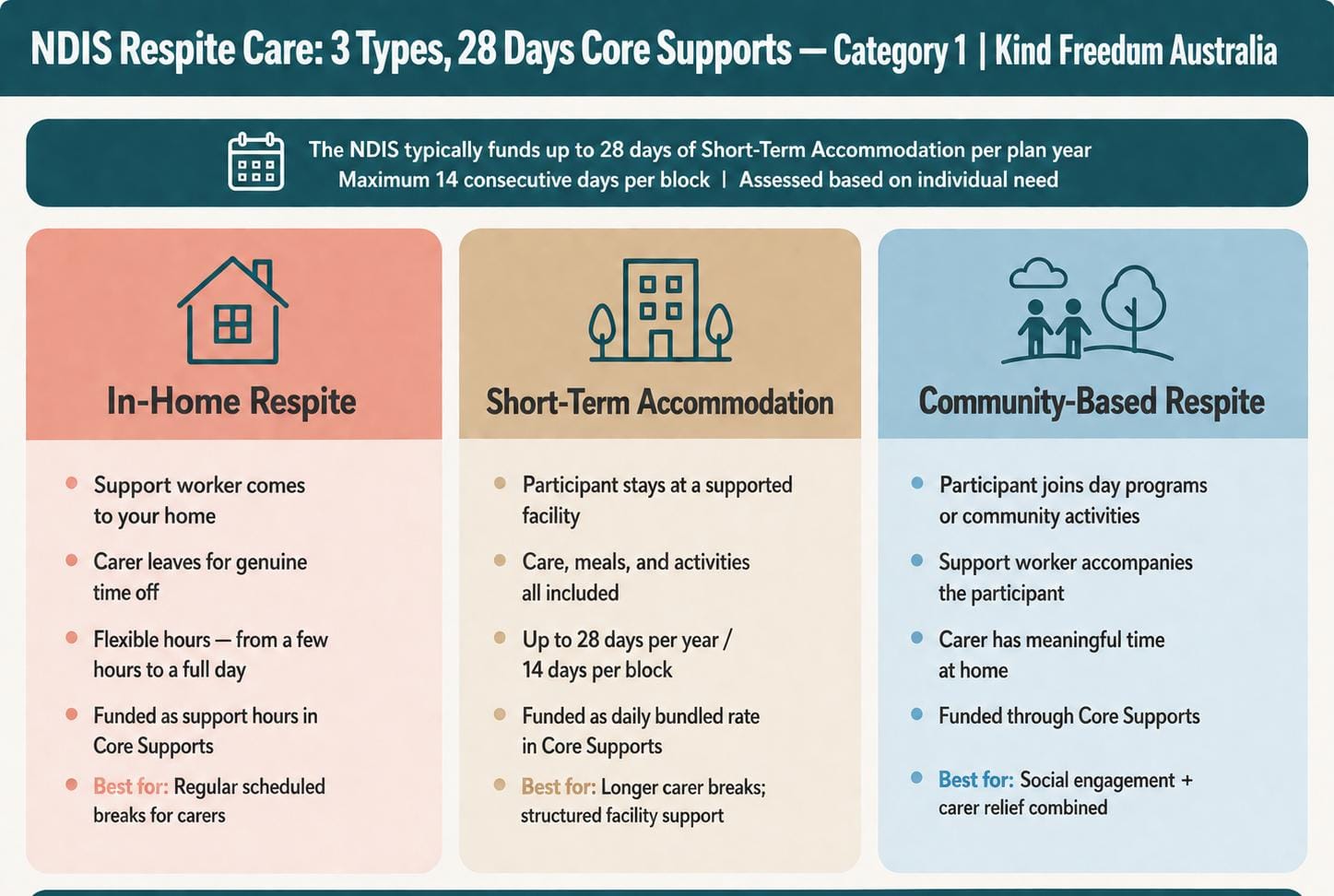
Not all respite works the same way. The NDIS funds three distinct models, and many participants use more than one depending on their plan and circumstances.
Short-Term Accommodation
Short-term accommodation commonly called residential respite, or STA is when the participant stays at a supported accommodation facility for a set number of days while their career takes a break. The participant is fully supported at the facility throughout the stay. The career has real, uninterrupted time away.
STA is funded as a bundled daily rate that covers accommodation, personal care and support, meals and day-to-day living costs during the stay, and activities provided by the facility. It is the most structured form of respite and the type with the most specific funding rules attached to it.
In-Home Respite
In-home respite means a support worker comes to the participant's home so the career can leave. The participant stays in their own environment. The career gets genuine time off to sleep, attend appointments, spend time with other family members, or simply rest without being on call.
This model works well when the participant is comfortable at home and when the primary goal is giving the career time away rather than a change of setting for the participant. It is also the most flexible form of respite sessions can be a few hours, a full day, or overnight, depending on what the career needs and what is funded in the plan.
Community-Based Respite
Community-based respite means the participant accesses activities, day programs, or social outings with support giving the career meaningful time off while the participant is engaged with something outside the home.
This is distinct from community participation funding in that the primary driver here is career relief, not the participant's social goals. In practice the two often overlap: a participant attending a well-matched day program benefits directly from the activity, and the career benefits from the time. Both outcomes are real and both matter.
How Many Days of NDIS Respite Care Can You Get?
This is the question at the centre of most respite conversations and the answer has a specific figure attached to it.
For short-term accommodation, the NDIS typically funds up to 28 days per plan year.
This is the standard planning benchmark for participants whose informal career requires significant respite support. Within that allocation:
The maximum consecutive block in a single STA stay is generally 14 days before a break is required between bookings
The 28 days can be split across the year in whatever pattern suits the participant and career four blocks of seven days, two fortnights, or a mix of shorter and longer stays
Unused STA days do not carry over to the next plan unspent days expire at the end of the plan period
This is not an automatic entitlement. The number of STA days in any individual plan depends on the participant's assessed needs and the level of support provided by their informal career. Some participants receive fewer days. Others with more intensive caring arrangements or higher support needs may receive more. The 28-day figure is a useful benchmark for planning conversations, not a guaranteed allocation.
In-home and community-based respite do not work on a day-based allocation in the same way. They are funded as support hours within the Core Supports budget, based on an assessed number of hours per week or month that the carer requires relief.
💡 Pro Tip: If your plan review is coming up and you want more respite included, document your caring role clearly before the meeting. Note how many hours per week you provide informal support, what specific tasks you cover, and how any current respite funding has been used. The NDIS needs to see genuine career needs a clear, honest account of the daily caring load is far more effective than a general request for more funding.
What Does NDIS Respite Funding Cover?
Short-term accommodation funding covers:
The daily cost of the STA facility, including accommodation and support bundled together
Personal care and assistance throughout the stay
Meals and daily living costs during the stay
Activities and programs provided by the facility
In some plans, transport to and from the facility check your specific plan
What NDIS respite funding does not cover:
Not Covered | Why |
The participant's everyday living costs at home during an STA stay | NDIS funds disability support, not general living expenses |
Activities or outings not arranged by the STA provider | Additional outings may need separate funding from another part of the plan |
Support services for the career directly | Carers access support through Career Gateway not through the participant's NDIS plan |
The carer's personal expenses during their break | Career personal costs are outside the scope of the participant's plan |
Extended stays beyond the funded allocation without prior approval | Days beyond the funded amount must be self-funded or separately approved through a plan review |
What Happens If You Need Emergency Respite?
Planned respite is ideal. But caring situations do not always follow a plan. If a career experiences a sudden health event, a family emergency, or simply reaches a genuine point of crisis, emergency respite can be accessed outside the normal planning cycle.
Emergency respite is typically arranged through:
Career Gateway (1800 422 737) the national career support service, which can arrange short-term crisis respite quickly and is specifically resourced for urgent situations
The NDIS itself, via an unscheduled plan review if additional STA funding is needed and the current plan does not have sufficient allocation
State-based disability emergency services in Victoria where relevant
If you are a career and reach a genuine crisis point, contact Career Gateway first. They can move quickly. NDIS plan reviews take time and Career Gateway exists precisely to fill that gap in urgent situations.
How Is NDIS Respite Care Funded?
Short-term accommodation is funded under the participant's Core Supports budget specifically under Assistance with Daily Life (Category 1). It appears as a separate named line item in the plan, listed as Short Term Accommodation.
In-home respite hours are also typically funded under Core Supports, within the daily living budget. Community-based respite may draw from either daily living or community participation funding depending on what the sessions involve.
An important point about assessment: Respite funding is determined by the participant's support needs AND the caring arrangements currently in place. If the participant has significant family support, the NDIS factors that in. If the career has their own health limitations or is at risk of burnout, that is directly relevant to the funding decision and it should be raised explicitly at the plan review.
Self-managed and plan-managed participants can access unregistered providers for in-home and community-based respite. For residential STA, the accommodation facility itself is generally a registered NDIS provider.
How to Get NDIS Respite Care in Your Plan
Respite funding does not appear automatically in every NDIS plan. It needs to be requested, justified, and connected to the participant's goals and the carer's situation. Here is how to approach it effectively.
Before your plan review, prepare the following:
A clear account of how many hours per week your career currently provides informal support and what tasks they cover
Any information about the carer's own health that affects their ability to sustain the current caring role
A record of how existing respite funding has been used, if any
A supporting letter from the participant's GP, OT, or treating specialist where the career has relevant health concerns
During the plan review:
Ask specifically for STA days to be included as a named line item do not assume it will be added automatically
Request in-home respite hours separately if you want flexible, regular career relief that does not depend on residential stays
Frame the request around what the carer needs to sustain their role, not only what the participant would prefer
If your current plan has no respite funding and your caring situation has recently changed due to the carer's health, a change in the participant's support needs, or the loss of other informal support you can request an unscheduled plan review rather than waiting. Document the change clearly and contact your LAC or the NDIS directly on 1800 800 110 to initiate the process.
Who Is Eligible for NDIS Respite Care?
Respite care is relevant for participants who have an informal career typically a family member or partner who provides substantial support on a regular basis. The NDIS funds respite where:
The participant's disability requires significant daily support that is currently being provided informally by a career
The carer's wellbeing, health, or long-term capacity to continue is at genuine risk without regular breaks
The participant has goals related to new experiences, independence in supported settings, or building confidence away from home
The participant would benefit from structured activities or programs that STA or day programs provide in addition to the career relief those stays offer
Respite is relevant across a wide range of conditions physical disability, neurological conditions, acquired brain injury, multiple sclerosis, Parkinson's disease, and others. The determining factor is the intensity and regularity of the caring role, not the specific diagnosis.
How Kind Freedom Supports Respite Care
Kind Freedom's respite care service provides in-home and community-based respite support for self-managed and plan-managed participants across Melbourne. The focus is on consistent, high-quality support so careers can genuinely step away rather than hand over to someone unfamiliar who needs to be briefed from scratch each session.
As a Certificate IV Allied Health Assistant, Edson designs respite sessions with the participant's specific condition in mind. For participants living with MS, Parkinson's disease, acquired brain injury, or post-stroke recovery, respite sessions can incorporate prescribed therapy exercises or home management tasks recommended by a physiotherapist or occupational therapist making each funded hour count for more than one purpose.
For participants planning a residential STA stay, Kind Freedom can assist in preparing clear documentation of the participant's support needs so the transition into and out of the facility is as smooth as possible for both the participant and their career.
Kind Freedom works with self-managed and plan-managed participants across Melbourne's western suburbs, northern suburbs, inner Melbourne, and south-east. We do not work with NDIA-managed participants.
For a broader overview of how NDIS supports work across Melbourne, see our guide to NDIS services in Melbourne.
Need NDIS Respite Care? Here's Your Next Step
Caring without a break is not sustainable long-term. The NDIS acknowledges this by building respite funding into plans for participants with significant caring arrangements. The question is not whether to use it it is ensuring it is in the plan in the first place, and that it is structured in a way that gives carers genuine, usable time off.
If respite is not currently in your plan, or if you have STA days sitting unused because the logistics of organising a stay have felt too complicated, the next planning conversation is the right moment to address it.
Reach out to Kind Freedom we will have a direct conversation about your current support arrangements and help you think through what respite options make sense for your situation.
For more on how NDIS daily living support and respite care can work together within the same Core Supports budget, see our related guide.
Written by
Edson Rushenya
Kind Freedom Australia blogger.