

Overview
This guide covers 10 essential questions to ask any NDIS provider before you commit including what a good answer sounds like and what a red flag sounds like for each one. You'll also find a quick-reference summary table, a post-conversation checklist, and pro tips placed throughout to help you get more from each question. Read time: approximately 8 minutes.
Table of contents
(38 sections)
Table of contents
(38 sections)Choosing an NDIS provider is an important decision because the support you receive can have a direct impact on your daily life.
Whether you need assistance at home, help getting involved in your community, or support to build new skills, you'll want a provider who understands what matters most to you.
Many providers offer similar services, but the way they deliver those services can be very different.
One provider may take the time to understand your goals and communicate regularly, while another may focus mainly on scheduling appointments. Asking thoughtful questions helps you look beyond the list of services and understand how each provider works with participants.
It's also an opportunity to decide whether you feel comfortable with the people who may become part of your support network.
Before You Pick Up the Phone
The questions below apply to any NDIS provider allied health, support workers, therapy assistants, community participation, personal care. Some are more relevant to certain support types, and where that's the case, it's noted.
You don't need to work through all ten in a single call. The first three or four will tell you a great deal.
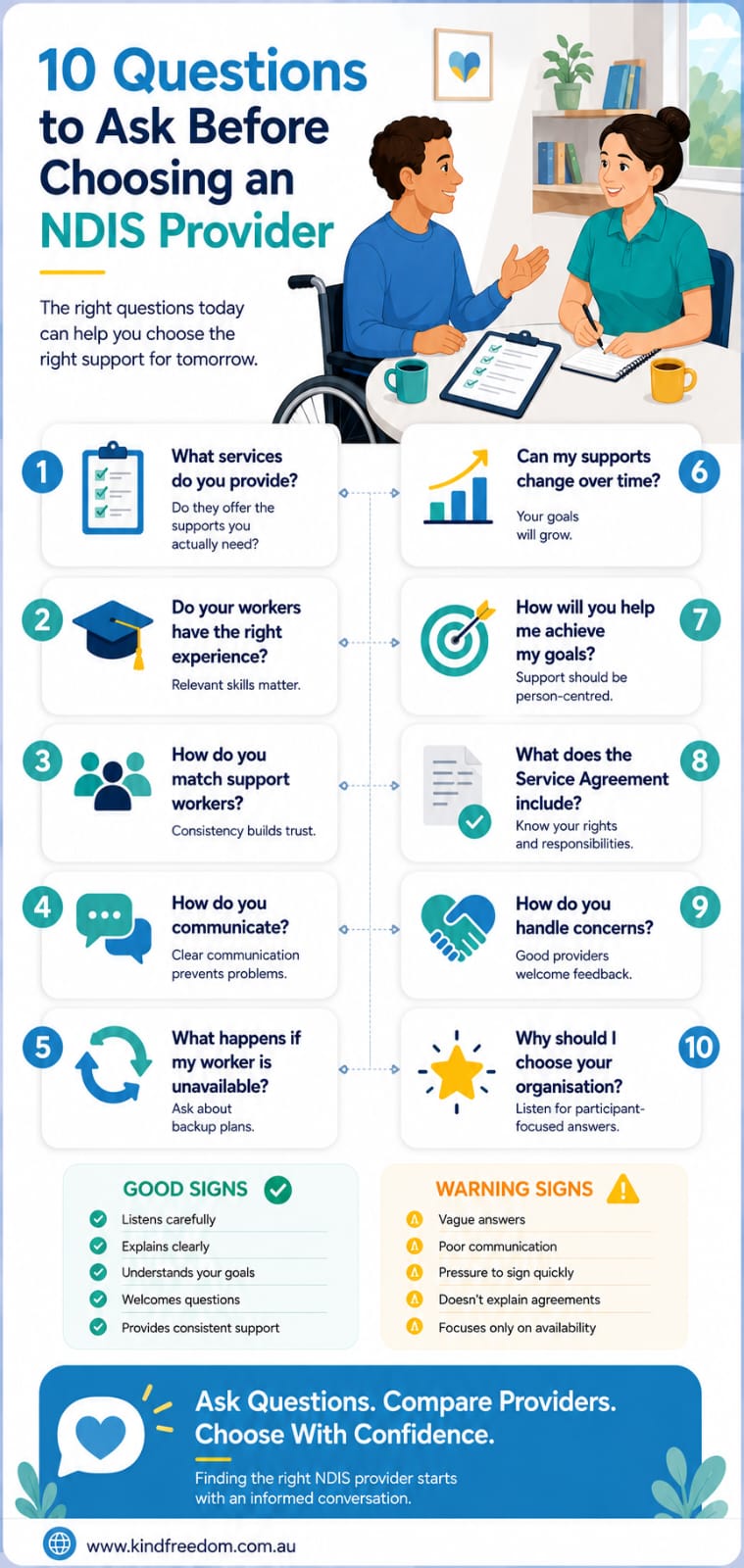
1: What Services Do You Provide?
This is usually the first question people ask, but it's worth going a little deeper than simply requesting a list of services.
Ask the provider to explain how their supports work and how they tailor services to each participant.
For example, if you're looking for help with daily living or community participation, ask how they support participants in achieving greater independence rather than simply completing tasks for them.
Why This Question Matters
Not every provider offers the same support or specialises in the same areas.
Understanding their experience helps you decide whether they're likely to meet your current and future needs.
A Good Answer Sounds Like
The provider clearly explains their services, asks about your goals, and discusses how they personalise support rather than offering a one-size-fits-all approach.
A Potential Red Flag
The provider gives only general answers or avoids explaining how their services are delivered.
2: Are You Registered with the NDIS Quality and Safeguards Commission?
Ask this early not because unregistered providers are inferior, but because the answer determines whether you can actually use them.
If your plan is NDIA-managed:
You can only access registered providers. An unregistered provider cannot invoice the NDIA directly, so they cannot work with you regardless of how good they are.
If your plan is self-managed or plan-managed:
Both registered and unregistered providers are available to you. An unregistered provider may offer you more flexibility, faster access, and more specialist expertise, or they may not. Registration status alone doesn't determine quality.
What a good answer sounds like:
A direct, confident answer either way "Yes, we are registered" or "We are unregistered and work with self-managed and plan-managed participants only" followed by clarity about what that means for your specific plan type.
What a red flag sounds like:
Vagueness, uncertainty, or a provider who doesn't know their own registration status. Any reputable provider knows this immediately.
3: What Qualifications Do Your Workers Hold?
The NDIS does not require support workers to hold formal qualifications which means the sector varies enormously. Some workers are Certificate III or IV trained. Others are not formally trained at all. For personal care and community support, the minimum requirements are relatively low. For therapy and allied health support, they are more specific.
For Allied Health Assistant roles specifically:
Workers should hold a Certificate IV in Allied Health Assistance as a minimum, and all sessions should be conducted under the supervision of a registered physiotherapist, occupational therapist, or other allied health professional.
For support workers:
Ask about minimum qualifications, first aid certification, and whether ongoing training is provided.
What a good answer sounds like:
Specific and immediate — naming the qualification, mentioning clinical supervision for AHA roles, and offering to share documentation if needed.
What a red flag sounds like:
"All our workers are experienced" experience is not a qualification. Or: "They've done induction training" with nothing more. Or: an AHA provider who cannot name the supervising clinician.
💡 Pro Tip "Can I see a sample certificate or qualification document for the worker assigned to me?" A confident, qualified provider will offer this without hesitation. If the response is reluctance or a change of subject, that tells you what you need to know.
4: How Do You Communicate With Participants and Families?
Good communication is one of the biggest signs of a reliable NDIS provider.
You'll want to know how the provider shares important updates, responds to questions, and keeps everyone informed about your supportt
If a family member, carer, or Support Coordinator is involved in your care, ask how they'll communicate with them while respecting your privacy and preferences.
Why This Question Matters:
Clear communication helps avoid misunderstandings and makes it easier to adjust your support when your needs change.
It also helps build trust between you and your provider.
A Good Answer Sounds Like:
The provider explains how they'll stay in touch, who your main contact person will be, and how quickly they usually respond to phone calls or emails.
A Potential Red Flag:
It's difficult to find out who to contact, or the provider gives unclear answers about communication and response times.
5: What Happens if My Regular Support Worker Is Unavailable?
Even the most reliable providers occasionally need to adjust schedules due to illness, annual leave, or unexpected circumstances.
The important question is how they manage those situations.
Ask whether they'll arrange another support worker and how they'll keep you informed about any changes.
Why This Question Matters
Reliable backup arrangements help reduce interruptions to your supports and give you confidence that you'll continue receiving assistance when you need it.
A Good Answer Sounds Like
The provider explains their backup process, introduces replacement workers where possible, and communicates any changes as early as they can.
A Potential Red Flag
The provider doesn't have a clear plan or can't explain what happens when a support worker isn't available.
7: How Quickly Can You Start?
Timing matters. If you have just had a stroke, are post-hospital discharge, or are mid-plan with months of Capacity Building funding unspent, a provider with a three-month waitlist is not useful to you right now regardless of how good they are.
Ask specifically about the timeline from first contact to first session.
What a good answer sounds like:
A specific timeframe. "We can typically start within two to three weeks of the initial assessment" or "We have availability now in [suburb]."
What a red flag sounds like:
Vague language "we'll put you on our list" or "it depends." If a provider cannot give you an estimated start date, ask directly: do you have a waitlist, and if so, how long is it?
8: How Do You Communicate with My Family, Carers, or Support Coordinator?
For many NDIS participants particularly those with acquired brain injuries, neurological conditions, or children with complex support needs family members and support coordinators are deeply involved in the day-to-day. A provider who does not communicate proactively with the people around the participant creates gaps, inconsistencies, and missed progress.
What a good answer sounds like:
"We provide session notes after each visit. We communicate directly with your support coordinator and are happy to involve family members in goal-setting and progress reviews."
What a red flag sounds like:
Communication described as the participant's responsibility to manage. Or: no clear process for sharing session notes with the supervising clinician or family.
Compare the Answers, Not Just the Services
After speaking with a few providers, you'll probably notice that many offer similar services.
What often makes the difference is how they answer your questions.
Use a simple comparison table like this while you're researching.
Question | Provider A | Provider B | Provider C |
Explained services clearly | ✔ | ✔ | ✔ |
Asked about my goals | ✔ | ✔ | ✔ |
Communication felt professional | ✔ | ✔ | ✔ |
Backup support worker available | ✔ | ✔ | ✔ |
Flexible approach to changing needs | ✔ | ✔ | ✔ |
I felt comfortable talking with them | ✔ | ✔ | ✔ |
A Good Conversation Should Feel Like a Two-Way Discussion
Remember, you're not attending a job interview, you're choosing people who may become an important part of your everyday life.
A good provider won't simply talk about their organisation.
They'll take time to learn about you.
By the end of the conversation, you should feel that they've listened to your concerns, understood your goals, and answered your questions honestly.
If you leave feeling informed, respected, and comfortable, that's usually a positive sign.
9: What Happens If I'm Not Happy with the Service?
Every provider should have a clear, accessible complaints process. If they don't or if they seem uncomfortable being asked that is information about how they will handle things when problems arise.
What a good answer sounds like:
"We have a formal complaints process. You can raise concerns directly with your support coordinator, with the provider principal, or with the NDIS Quality and Safeguards Commission. We take feedback seriously and act on it."
What a red flag sounds like:
Defensiveness. Or: a vague "we'll work it out" response with no process behind it.
10: Why Should I Choose Your Organisation?
This final question gives providers an opportunity to explain what makes their approach different.
Listen carefully to how they answer.
Do they spend most of the conversation talking about themselves, or do they explain how they'll support you?
The strongest answers usually focus on participants rather than the organisation.
Why This Question Matters
This question helps you understand the provider's values, approach to support, and commitment to participant outcomes.
It can also help you decide whether their way of working aligns with what you're looking for.
A Good Answer Sounds Like
The provider explains how they personalise support, build long-term relationships, and work alongside participants to achieve meaningful goals.
A Potential Red Flag
The conversation focuses only on awards, years in business, or company size without explaining how participants benefit from their services.
Common Mistakes to Avoid
Asking the right questions is important, but it's equally important to avoid common mistakes during the decision-making process.
Choosing Based on Availability Alone
It's understandable to want support as soon as possible, but availability shouldn't be the only reason for choosing a provider.
Take time to consider whether they understand your goals and can provide the quality of support you're looking for.
Comparing Only Prices
NDIS pricing is generally guided by the NDIS Pricing Arrangements and Price Limits.
Instead of focusing only on cost, think about the overall experience you'll receive.
Reliable communication, consistent support, and person-centred care often make a much bigger difference in the long term.
What the Answers Tell You At a Glance
Question | Red Flag | Good Sign |
|---|---|---|
Staffing consistency | "Pool of workers / rostering" | Named primary person, clear continuity plan |
Registration status | Vague or uncertain | Immediate, clear answer with implications explained |
Worker qualifications | "Experienced" without specifics | Named qualification, clinical supervision mentioned |
Clinical supervision | No named clinician | Named registered clinician, fortnightly review |
Service agreement | Long notice periods, locked packages | Clear exit terms, two to four week notice |
Condition experience | "We work with all disabilities" | Specific, grounded, willing to discuss approach |
Start time | Waitlists, vague timelines | Specific timeframe offered |
Communication | No clear process | Session notes, coordinator contact, family involvement |
Complaints | Defensiveness or vagueness | Clear process, reference to NDIS Commission |
Plan type | Uncertainty or assumptions | Immediate clear confirmation |
Conclusion
Choosing an NDIS provider is one of the most important decisions you'll make as an NDIS participant.
The right provider should do more than deliver services. They should listen to your goals, communicate openly, respect your choices, and work alongside you to help you achieve greater independence.
By asking thoughtful questions and comparing providers carefully, you'll be in a much stronger position to choose support that genuinely meets your needs.
Take your time, trust your instincts, and don't be afraid to explore your options. A little extra research today can help you build a positive and rewarding relationship with your provider for years to come.
Written by
Edson Rushenya
Kind Freedom Australia blogger.