

Overview
Many NDIS participants have Capacity Building funding in their plan but aren't sure what it covers or how to use it. This guide explains each Capacity Building category, highlights the importance of Category 15 (Improved Daily Living), and shows how these supports can help you build skills, maintain independence, and make the most of your NDIS funding.
Table of contents
(13 sections)
Table of contents
(13 sections)There is a budget category sitting inside many NDIS plans that participants routinely end their plan year having barely touched. Not because they didn't need what it covers. Because nobody clearly explained what it was for or that if it goes unspent, it doesn't carry forward into the next plan. That budget is Capacity Building.
It is one of the three core funding streams in every NDIS plan, and it is consistently the most misunderstood. Participants who know their Core Support budget down to the last dollar are sometimes completely unaware that they also have Capacity Building funding or what they're actually allowed to spend it on.
This article explains Capacity Building in plain English: what it is, what each category covers, what it funds for people with specific conditions, and how to make sure you're actually using what the NDIS has allocated to you.
💡 Pro Tip
Review your NDIS plan early in the plan year, not just before your plan review. If your plan includes Capacity Building funding, starting supports sooner gives you more time to work towards your goals and reduces the risk of leaving valuable funding unused.
Key Takeaway
Capacity Building funding isn't designed to help someone do things for you, it's designed to help you build the skills and confidence to do more for yourself.
The Three NDIS Funding Streams Where Capacity Building Sits
Every approved NDIS plan contains funding across up to three budget types. Understanding how they differ is the foundation for understanding why Capacity Building often goes unused.
Budget Type | What It Covers | Flexibility |
Core Supports | Day-to-day assistance personal care, community participation, daily living, transport | High, you can move funding between most Core categories |
Capital Supports | Equipment, home modifications, assistive technology | Locked must be spent on the specific item approved |
Capacity Building | Building skills and independence , therapy, training, support coordination | Locked to category spending in one CB area cannot move to another |
The key detail in that table: Capacity Building funding is locked to its category. If your plan includes $4,000 in Improved Daily Living Skills (Category 15), that money can only be spent on supports that fall under that category. You can't move it to Core Support if you don't use it and you can't carry it into your next plan if the year ends.
This is the single most common reason Capacity Building goes unspent. Participants don't realise the clock is running.
The Eight Capacity Building Categories
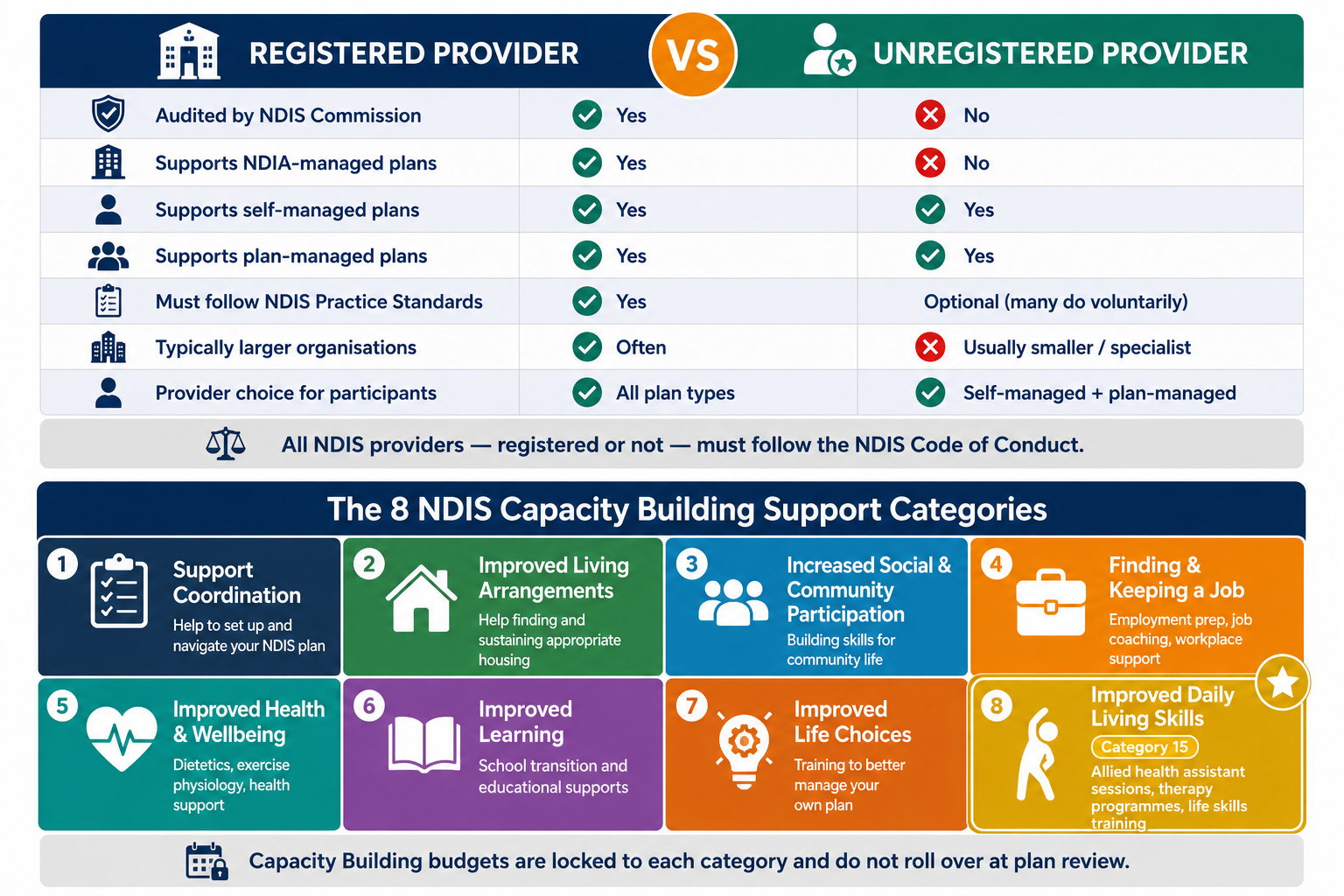
Capacity Building is not one thing; it is eight distinct funding categories, each targeting a different area of life. Your plan may include one, several, or all of them, depending on what was approved in your planning meeting.
Category | What It Funds |
CB Support Coordination | A support coordinator to help you set up and navigate your plan |
CB Improved Living Arrangements | Help finding and sustaining appropriate housing |
CB Increased Social & Community Participation | Skill-building to participate more independently in community life |
CB Finding & Keeping a Job | Employment preparation, job coaching, workplace support |
CB Improved Health & Wellbeing | Dietetics, exercise physiology, and related health supports |
CB Improved Learning | Transition from school, educational supports |
CB Improved Life Choices | Training to help you better manage your own plan |
CB Improved Daily Living Skills (Category 15) | Allied health assistant sessions, therapy programmes, life skills training |
Of these eight, Category 15 , Improved Daily Living Skills is the one most directly relevant to participants with physical disabilities, neurological conditions, or complex support needs. It is also the most underspent, because what it funds is frequently misunderstood.
What Category 15 Actually Pays For
Here is what Category 15 actually funds:
Allied Health Assistant (AHA) sessions. An AHA is a trained allied health worker who delivers therapy programmes designed and supervised by a registered clinician, a physiotherapist, occupational therapist, or speech pathologist. They come to your home, or wherever your programme is delivered, and work with you on the goals your supervising clinician has set. This might be rebuilding upper limb function after a stroke, managing gait freezing in Parkinson's disease, building daily living skills after a brain injury, or improving balance and coordination in MS.
AHA sessions under Category 15 are typically available at two levels:
Level 1 (Item 15_052_0128_1_3): Standard therapy assistant sessions , $56.16/hr (2025–26 rate)
Level 2 (Item 15_053_0128_1_3): Complex needs requiring higher clinical supervision — $86.79/hr (2025–26 rate)
Life skills programmes. If you want to build skills in cooking, budgeting, managing your own home, public transport, or any other area of daily life, these can be funded under Category 15.
Skill-based group programmes. Structured programmes run by allied health professionals targeting specific functional skills.
Therapy assistant sessions under OT or speech pathology supervision. Not just physiotherapy , any registered allied health professional can supervise an AHA programme.
Why So Many Participants Don't Use Their Capacity Building Funding
Many NDIS participants have Capacity Building funding in their plan but never use it to its full potential. This usually isn't because they don't need the support,it's because they aren't sure what the funding covers or how to access the services available.
Unlike Core Supports, which are often used for everyday assistance, Capacity Building focuses on developing skills, improving independence, and helping participants achieve long-term goals. Because it's less familiar, many people overlook it or assume it's only for complex therapy needs.
Understanding what your Capacity Building funding can be used for is the first step towards making informed decisions, accessing the right supports, and getting the full value from your NDIS plan.
Why Capacity Building and Core Supports Are Not the Same Thing
This is one of the most common points of confusion among NDIS participants, and almost no competitor content explains it clearly.
Both budgets can fund people coming to your home to help you. The difference is the purpose of that support.
Core Supports — Assistance with Daily Life pays for someone to assist you with tasks you currently cannot do independently. This support is ongoing because the need is ongoing.
Capacity Building — Improved Daily Living Skills pays for someone to work with you clinically, under professional supervision, specifically to improve or maintain your function over time. The goal is always to either increase independence or slow decline not simply to complete a task.
This is why AHA sessions sit in Capacity Building, not Core Supports. The AHA is not doing things for you. They are running a structured programme designed by your physio or OT that over weeks and months changes what you can do yourself.
Many participants who could benefit from AHA sessions under Category 15 are unaware this funding exists because they think of Capacity Building as a separate, specialist category that doesn't apply to them. If your condition affects your physical function, your coordination, your daily independence, or your ability to do things you used to be able to do Category 15 was designed for exactly that situation.
Which Conditions Benefit Most from Capacity Building (Category 15)
Category 15 is particularly relevant for participants living with:
Stroke — Rebuilding motor function, upper limb strength, and daily task capacity after a cerebrovascular event
Multiple Sclerosis — Managing fatigue, balance, coordination, and maintaining function through relapse and remission cycles
Parkinson's Disease — Structured programmes to slow functional decline, manage gait freezing, and maintain fine motor control
Acquired Brain Injury (ABI) — Cognitive and physical rehabilitation strategies under OT supervision, addressing sequencing, memory, and coordination
Spinal Cord Injury — Upper body strengthening, functional mobility, and independence training
Cerebral Palsy — Targeted movement programmes, life skills development, and community independence building
Chronic pain and fatigue conditions — Exercise physiology and movement-based programmes with clinical oversight
This is not an exhaustive list. If a registered physiotherapist, occupational therapist, or speech pathologist has identified goals related to your functional capacity or daily independence, Category 15 is likely the right funding vehicle.
The Underspending Problem and Why It Matters
Research into NDIS plan utilisation has consistently shown that Capacity Building is the most underspent of the three budget types. The reasons are worth understanding because they affect how participants plan their year.
Reason 1: Participants don't know the funding is there. Plans are approved and sent out with several lines of funding. Not every participant reads their plan in detail, and not every LAC or support coordinator walks participants through each budget and what it covers.
Reason 2: Referrals don't happen automatically. A GP or neurologist may know you'd benefit from intensive allied health support, but they won't automatically refer you to an AHA programme funded through your NDIS plan. The connection between the clinical recommendation and the NDIS funding pathway often doesn't get made unless someone in your support team actively bridges it.
Reason 3: The "I'll start next month" delay. Capacity Building is sometimes treated as something participants will get to after they've sorted out their Core Supports. Months pass. The plan year ends. The funding is gone.
How to Find Out If Your Plan Includes Capacity Building
You don't need to wait for your next appointment to find out.
Via the myGov NDIS portal: Log in at my.gov.au, navigate to your NDIS plan, and look for the budget breakdown. Capacity Building will be listed separately from your Core Supports. Each sub-category will show an approved amount.
Via your plan manager: If you are plan-managed, your plan manager has a breakdown of every budget category. A quick email or phone call will tell you exactly what Capacity Building funding you have, how much has been spent, and what remains.
Via your support coordinator: If you have a support coordinator (also funded through Capacity Building, under Support Coordination), that is exactly the kind of question they should be helping you answer.
If you are self-managed and have been managing your own invoicing, log in to the NDIS portal and check the budget screen it shows remaining funding per category in real time.
How to Request Capacity Building at Your Next Plan Review
If your current plan doesn't include Capacity Building or includes less than you need your plan review is the opportunity to change that.
The NDIS makes funding decisions based on evidence. Walking into a plan review saying "I'd like Capacity Building" without supporting evidence is unlikely to result in a strong outcome. Walking in with documented clinical goals is a different conversation.
Here is what to prepare:
Get a written recommendation from your treating clinician. Your physiotherapist, occupational therapist, or GP should be able to write a brief letter outlining why structured capacity building support, specifically AHA sessions under Category 15 , is clinically indicated for your condition and goals. Reference your diagnosis, current functional limitations, and what the programme is expected to achieve.
Connect the recommendation to your NDIS goals. The NDIS funds support that are "reasonable and necessary" and connected to your plan goals. If your goals include things like increasing independence at home, participating more in the community, or managing daily tasks and a clinician is recommending a programme that works toward those goals the connection is clear.
Ask your support coordinator or plan manager to help you prepare. They can help you frame your request in language that aligns with how the NDIS makes funding decisions.
Be specific about frequency and duration. "I would like some therapy support" is less persuasive than "I am requesting 48 AHA sessions at Level 1 over twelve months, two sessions per week, under physiotherapy supervision, to address the functional goals outlined in the attached clinical letter."
Common Mistakes That Lead to Unused Capacity Building Funding
Many participants don't intentionally leave their Capacity Building funding unused. In most cases, it's because of small misunderstandings that build up over the course of the plan year. Here are some of the most common mistakes to avoid:
Waiting until the end of the plan year: It's easy to put Capacity Building supports on hold while focusing on everyday needs. Starting early gives you more time to work towards your goals and get the most from your funding.
Assuming all supports come from Core Supports: Many participants don't realise that therapy-based supports, such as Allied Health Assistant services, are often funded through Capacity Building – Improved Daily Living, not Core Supports.
Not understanding what Category 15 covers: If you don't know what supports are available under Improved Daily Living, you may miss opportunities to build skills, improve independence, and work towards your therapy goals.
Not asking for guidance: Your support coordinator, plan manager, or allied health professional can help you understand your funding and recommend supports that align with your NDIS goals. Asking questions early can help you make informed decisions throughout your plan.
Making the Most of What's Already in Your Plan
Capacity Building is not a premium add-on for complex cases. It is a standard part of the NDIS funding framework, designed for exactly the kind of work that changes whether someone can cook their own meals, walk to the local shops, manage their morning routine, or get through a week without depending on family members to do things they used to do themselves.
The gap between having Capacity Building in your plan and actually using it is often not a funding problem. It is an information problem.
If you have Category 15 , Improved Daily Living Skills , in your plan, the question worth asking is not whether you're eligible to use it. You are. The question is whether you're using it well enough to get the outcomes it was funded to support.
Kind Freedom provides allied health assistant sessions under registered clinician supervision across Melbourne's western suburbs, including Sunshine, Footscray, Werribee, and Hoppers Crossing. We work with self-managed and plan-managed NDIS participants only.
→ Learn more about our Allied Health Assistant service: kindfreedom.com.au/services/allied-health-assistant → Talk to our team: kindfreedom.com.au/contact → Call us directly: 0405 458 852
Written by
Edson Rushenya
Kind Freedom Australia blogger.