

Overview
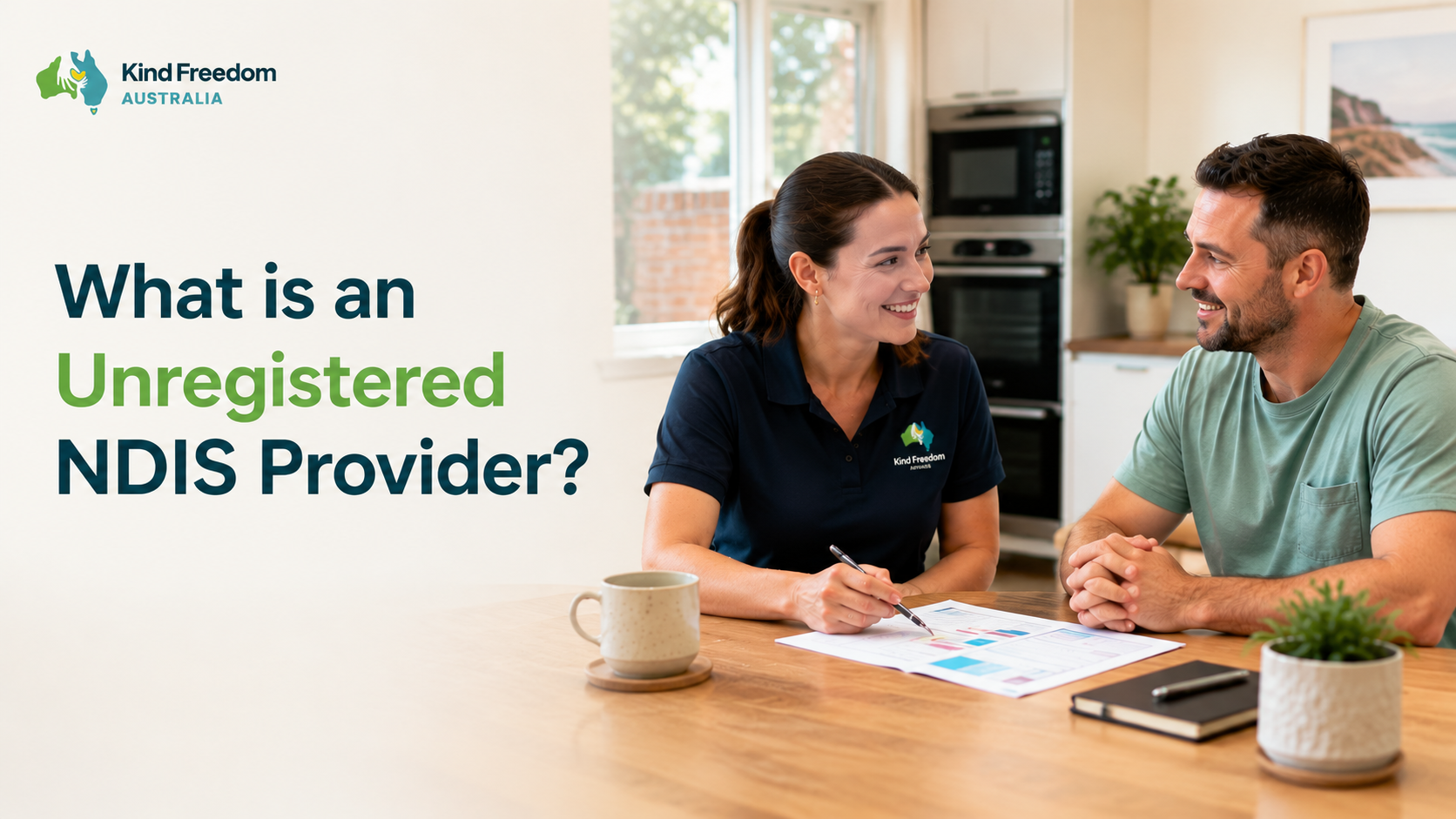
Not all NDIS providers are registered and that isn't necessarily a bad thing. If you're self-managed or plan-managed, choosing an unregistered provider can give you access to more personalised support, greater flexibility, and specialist services that may not be available through larger organisations. This guide explains what an unregistered NDIS provider is, how they differ from registered providers, who can use them, and what to consider before making your choice.
Table of contents
(16 sections)
Table of contents
(16 sections)When Lisa's support coordinator mentioned that the allied health assistant provider she was recommending wasn't registered with the NDIS Quality and Safeguards Commission, Lisa did what most people would do. She hesitated. She had spent two years navigating the NDIS to get funding for her teenage son, and the last thing she wanted was to choose the wrong kind of provider.
What her coordinator explained next surprised her. Unregistered providers are not a gap in the system. They are a legitimate and in many cases, better option for NDIS participants who have the right plan type. Thousands of participants across Australia access unregistered providers every week, and many of them do so quite deliberately.
If you've come across the term and aren't sure what it means for your situation, this guide explains it plainly.
Being an unregistered NDIS provider doesn't mean being unqualified. If your plan is self-managed or plan-managed, you can choose both registered and unregistered providers based on your needs.
What Does "Unregistered NDIS Provider" Actually Mean?
When someone delivers NDIS-funded support, they fall into one of two categories: registered or unregistered.
Registered providers: have applied to the NDIS Quality and Safeguards Commission, met a set of practice standards, undergone an audit, and been formally approved. They can invoice all three plan types: self-managed, plan-managed, and NDIA-managed.
Unregistered providers: have not gone through that registration process. This does not mean they are unqualified, unskilled, or operating outside the law. It means they have chosen not to undergo the registration audit often because their client base does not require it, because they are a smaller or specialist provider, or because the registration process is lengthy, costly, and not required for the participants they support.
An unregistered provider can still hold professional qualifications, carry insurance, complete NDIS Worker Screening Checks, and deliver high-quality support. Registration is a regulatory pathway not a quality guarantee.
Registered vs Unregistered NDIS Provider: Key Differences
Registered Provider | Unregistered Provider | |
Audited by NDIS Commission | Yes | No |
Can support NDIA-managed plans | Yes | No |
Can support self-managed plans | Yes | Yes |
Can support plan-managed plans | Yes | Yes |
Must follow NDIS Practice Standards | Yes | No (but good providers follow them voluntarily) |
NDIS Worker Screening required | Yes | Depends on support type and state |
Typically larger organisations | Often | Not always |
Niche/specialist providers | Sometimes | Very common |
The most important row in that table is the third one. If your plan is self-managed or plan-managed, you can legally and freely choose an unregistered provider.
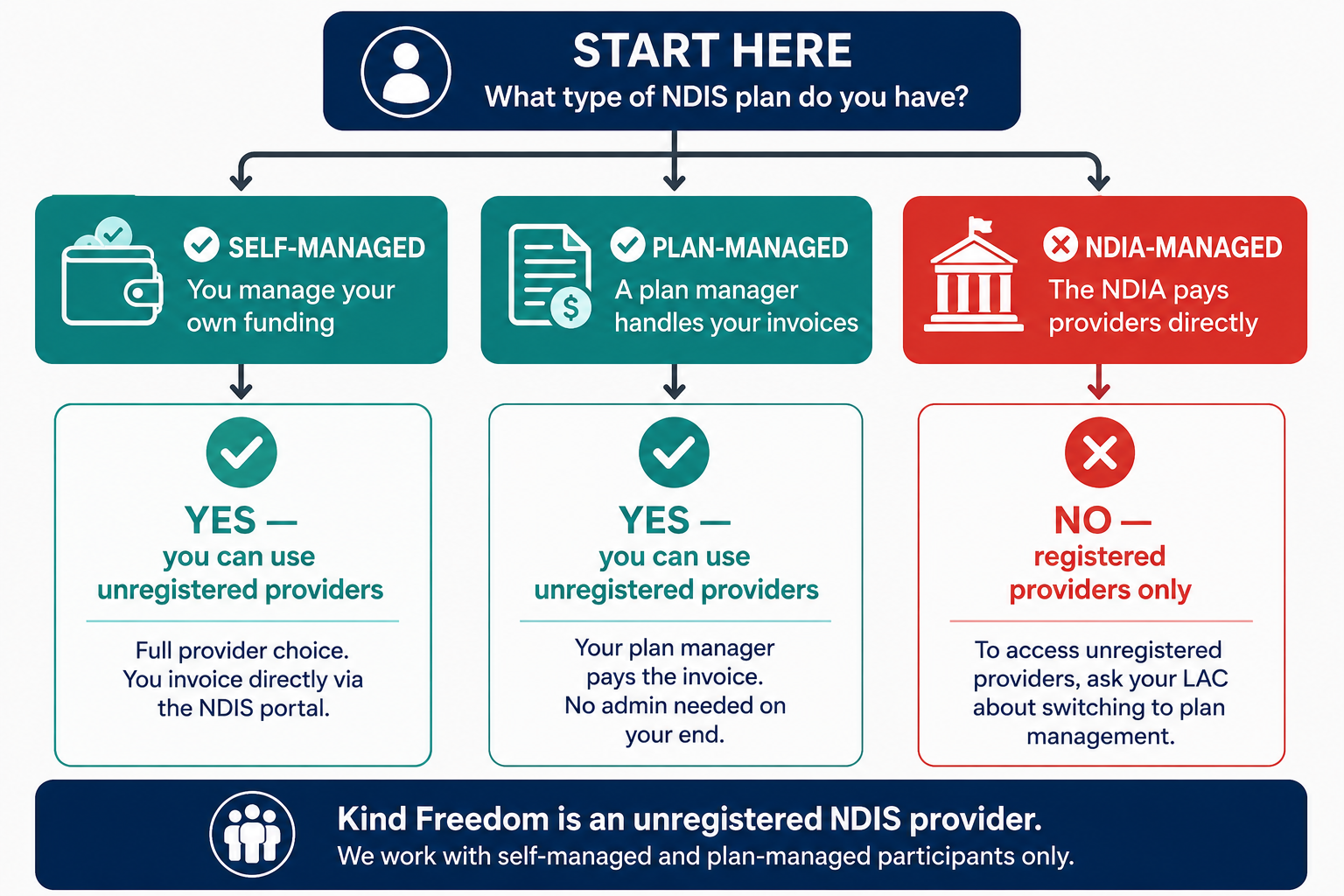
Which NDIS Plans Can Access Unregistered Providers?
This is where most of the confusion comes from. Whether you can use an unregistered provider depends entirely on how your NDIS plan is managed, not on your disability, your location, or your funding amount.
Self-Managed Plans
If you self-manage your NDIS funding, you have the widest provider choice available. You can access registered and unregistered providers, and you manage the invoicing yourself. Self-management is designed precisely to give participants more control over who they work with.
Plan-Managed Plans
If your plan is managed by a plan manager or a registered financial intermediary who pays your providers on your behalf you can also access unregistered providers. Your plan manager processes the invoices for you, so the administrative side is handled. You get provider choice without needing to manage the finances yourself.
NDIA-Managed Plans (Agency-Managed)
If the NDIA manages your funding directly, you can only access registered providers. The NDIA pays providers directly from your plan, and their systems are set up to work with registered organisations only.
If you are currently NDIA-managed and want to access an unregistered provider, you would need to switch to self-management or plan management first. This is possible, and your support coordinator or LAC can help you request it at your next plan review.
Why Many Participants Actively Choose Unregistered Providers
Choosing an unregistered provider is not a compromise. For many participants, it's a considered decision. Here's why:
Specialist expertise. Some of the most skilled allied health assistants, therapy support workers, and community participation providers operate as smaller, unregistered services. They don't need the overhead of registration because they work closely with a specific client group.
More flexibility. Unregistered providers are often more responsive, faster to start, more adaptable to participant needs, and less constrained by the standardised pricing and service packages that larger registered organisations typically offer.
Genuine relationships. Smaller, unregistered providers tend to offer more consistent staffing. You work with the same person week after week, rather than whoever is available from a rotating roster.
Local and community-based. Many providers who work exclusively in one region particularly in areas like Melbourne's western suburbs operate as unregistered services. They are embedded in the local community and understand its specific context.
No waitlists. Registered organisations with high NDIS volume often have significant waitlists. Unregistered providers, by nature, tend to be smaller and more nimble.
💡 Pro Tip
Don't judge a provider by their registration status alone. Instead, ask about their qualifications, experience, insurance, worker screening, and how they deliver quality support. The best provider is one that understands your goals, communicates openly, and provides the right support for your individual needs.
Who Should Consider an Unregistered NDIS Provider?
An unregistered NDIS provider may be the right choice if you value flexibility, personalised support, and greater choice over who delivers your services. This option is generally suitable for:
Self-managed participants who want complete control over choosing their providers.
Plan-managed participants who want more provider options without managing invoices themselves.
Families looking for personalised support from smaller, community-focused providers.
Participants seeking specialist services, such as Allied Health Assistants or therapy support.
People want shorter wait times, as many smaller providers can begin services sooner than larger organisations.
If your NDIS plan is NDIA-managed (agency-managed), you'll generally need to use registered providers unless your plan management arrangements change.
Is It Safe to Use an Unregistered Provider?
This is the question most participants and families ask, and it deserves a direct answer.
Yes, with appropriate due diligence.
Unregistered providers are not monitored by the NDIS Commission in the same way registered providers are. However, this does not leave participants without protection:
The NDIS Code of Conduct applies to everyone. All NDIS providers and workers registered or not are legally bound by the NDIS Code of Conduct. This covers things like acting with respect, delivering safe support, and not engaging in financial or physical abuse. Breaches can be reported to the NDIS Commission regardless of registration status.
The NDIS Worker Screening Check. In Victoria, workers delivering higher-risk supports including personal care and support for children are required to hold a current NDIS Worker Screening Check, regardless of whether the provider is registered. This clearance check looks at criminal history and past conduct.
Professional qualifications still apply. An unregistered allied health assistant is still required to hold their Certificate IV in Allied Health Assistance. An unregistered support worker still needs to hold relevant training and first aid. Registration status does not change the qualifications the individual worker must have.
What due diligence looks like in practice:
Ask the provider directly about their team's qualifications and screening status
Confirm they hold current public liability and professional indemnity insurance
Ask whether clinical staff are supervised by a registered practitioner (for therapy support)
Check that they are familiar with the NDIS Code of Conduct
Ask for references or, better yet, read published case studies or reviews
Common Misconceptions About Unregistered NDIS Providers
Because the term "unregistered" can sound concerning, it's often misunderstood. Here are a few common myths.
Myth 1: Unregistered Providers Aren't Qualified
Registration and qualifications are not the same thing. Many unregistered providers have experienced, qualified staff who meet the requirements needed to deliver high-quality NDIS support.
Myth 2: Unregistered Providers Can't Deliver NDIS Services
They can. Self-managed and plan-managed participants can legally access unregistered providers for many NDIS-funded supports.
Myth 3: Registered Providers Always Offer Better Support
Not necessarily. The quality of support depends on the provider's experience, professionalism, communication, and commitment to participant outcomes not simply their registration status.
What to Ask Before Choosing an Unregistered Provider
Before you sign a service agreement with any unregistered provider, run through these questions:
Question | What to Look For |
Are your workers NDIS screened? | Current NDIS Worker Screening clearances for relevant staff |
Are your staff qualified? | Certificate IV or above for allied health; relevant training for support workers |
Are you insured? | Public liability and professional indemnity insurance |
Do you have clinical supervision in place? | For AHA or therapy support, a registered clinician should supervise |
What happens if my regular support person is unavailable? | Clear continuity plan — not just "we'll find someone" |
Do you have a complaints process? | Any reputable provider should have one |
Can I see a sample service agreement? | Should outline support type, hours, pricing, and exit terms |
A provider who answers these questions clearly and without hesitation is a provider worth working with. One who can't answer them clearly deserves more scrutiny.
How to Start Using an Unregistered Provider
If your plan is self-managed or plan-managed, the process is straightforward:
Confirm your plan type. Log in to the myGov NDIS portal or check your welcome letter. Look for how your plan is managed.
Contact the provider. Have an initial conversation about your support needs and whether they're a good fit.
Review and sign a service agreement. This protects both parties and sets clear expectations.
For self-managed plans: The provider invoices you directly, and you submit the claim in the NDIS portal.
For plan-managed plans: The provider invoices your plan manager, who processes the payment. You don't need to manage any of the financial administration.
Conclusion
Being unregistered doesn't mean being unqualified, unaccountable, or unsafe. For participants with self-managed or plan-managed plans, unregistered providers open up a wider, more flexible, and often more personalised field of support options.
The right question to ask isn't "are they registered?" It's: are they qualified, are they insured, do they have clinical oversight in place, and do they show up consistently for the people they support?
Those are the things that determine quality. Registration is one pathway to accountability but it isn't the only one, and for many participants in Melbourne's western suburbs, the best fit has turned out to be a small, specialist, unregistered provider who actually knows their name.
Kind Freedom is an unregistered NDIS provider based in Melbourne's western suburbs. We support participants with allied health assistant sessions, daily living assistance, life skills support, community participation, and personal care under self-managed and plan-managed plans only.
→ Learn more about our services: kindfreedom.com.au/services → Get in touch: kindfreedom.com.au/contact → Call us: 0405 458 852
Written by
Edson Rushenya
Kind Freedom Australia blogger.