

Overview
Finding the right NDIS provider isn't just about choosing someone who offers the services you need. It's about finding a provider who understands your goals, listens to your preferences, and supports you in living the life you want. With hundreds of NDIS providers across Melbourne, comparing your options can feel overwhelming. Some providers specialise in daily living support, while others focus on community participation, allied health assistance, or more complex care. Knowing what to look for can help you make a confident and informed decision. This guide explains how to choose the right NDIS provider in Melbourne, the questions you should ask before making a decision, and the signs that a provider is genuinely focused on helping you achieve your goals.
Table of contents
(37 sections)
Table of contents
(37 sections)The support you receive through the NDIS plays an important role in your daily life. Whether you need assistance at home, support to participate in your community, or help building everyday skills, your provider becomes someone you interact with regularly.
That's why choosing the right provider deserves careful thought.
A provider who understands your needs can help you feel more confident, respected, and supported as you work towards your goals. On the other hand, poor communication, unreliable services, or support that doesn't match your expectations can make it harder to get the most from your NDIS plan.
Taking a little extra time to compare your options now can make a significant difference in your experience over the months and years ahead.
What Does an NDIS Provider Do?
Before comparing providers, it's helpful to understand their role.
An NDIS provider is an individual or organisation that delivers support and services funded through your NDIS plan. Depending on your needs, a provider may help with everyday activities, social participation, therapy support, or developing greater independence.
Common NDIS services include:
Assistance with daily living
Community participation
Personal care
Household tasks
Transport support
Allied Health Assistance
Capacity-building supports
Life skills development
Support coordination (where applicable)
Not every provider offers every service, which is why it's important to choose one that aligns with your individual goals and support needs.
Why Choosing the Right Provider Matters
Your NDIS plan is designed around your goals, and your provider should help you work towards achieving them.
The right provider doesn't simply deliver services. They take the time to understand what matters to you, communicate openly, and adapt their support as your needs change.
A good provider can help you:
Build greater independence.
Develop confidence in everyday activities.
Stay connected with your community.
Improve your quality of life.
Work towards long-term personal goals.
Feel respected and involved in decisions about your support.
The relationship should feel like a partnership rather than a one-size-fits-all service.
Start With Your Own Goals
One of the biggest mistakes people make is choosing a provider before thinking about what they actually want to achieve.
Before researching providers, take a few minutes to reflect on your goals.
Ask yourself:
What do I want to achieve over the next 12 months?
Which daily activities would I like more support with?
Do I want to become more independent?
Am I looking for greater community participation?
Do I need support after an illness, injury, or surgery?
Would I benefit from Allied Health Assistance?
Do I want consistent support workers?
Having clear goals makes it much easier to compare providers and decide whether they're the right fit.
Understand the Services You Need
Not every participant requires the same support.
Some people only need a few hours of assistance each week, while others require a broader range of services delivered by different professionals.
Before choosing a provider, make a list of the supports that are most important to you.
For example:
Support Need | Why It Matters |
Daily Living Assistance | Supports everyday independence at home. |
Community Participation | Helps you build confidence and stay connected with your community. |
Allied Health Assistance | Supports therapy programs under the guidance of qualified allied health professionals. |
Personal Care | Assists with everyday personal routines while promoting dignity and independence. |
Capacity Building | Helps develop practical skills and confidence over time. |
Should You Choose a Registered or Unregistered NDIS Provider?
This is one of the most common questions participants ask.
The answer depends largely on how your NDIS funding is managed.
If you're NDIA-managed, you'll generally need to use registered NDIS providers.
If you're self-managed or plan-managed, you may have the flexibility to choose either registered or unregistered providers, depending on your circumstances.
Rather than focusing only on registration status, consider whether the provider:
has relevant experience
communicates clearly
understands your goals
delivers reliable services
treats participants with respect
These qualities often have a greater impact on your day-to-day experience than registration alone.
Why Local Experience Matters
Choosing a provider based in Melbourne can offer practical advantages.
A local provider is often more familiar with:
community programs
local events
accessible facilities
transport options
healthcare networks
support services available in your area
This local knowledge can make it easier to connect with opportunities that support your independence and participation in everyday life.
It can also make communication and scheduling more convenient when face-to-face support is required.
What Makes a Great NDIS Provider?
Not all providers deliver support in the same way.
While services may look similar on paper, the experience can be very different.
A great provider is someone who:
✔ Take time to understand your goals.
✔ Communicates openly and respectfully.
✔ Responds promptly to questions.
✔ Delivers reliable and consistent support.
✔ Treats you as an individual rather than a number.
✔ Encourages your independence wherever possible.
✔ Review your support as your needs change.
✔ Works collaboratively with your family, therapists, or support network when appropriate.
Choosing a provider isn't about finding the biggest organisation, it's about finding the one that feels right for you.
What Should You Look for in an NDIS Provider?
Every provider will tell you they're committed to delivering quality support. The real difference lies in how they work with participants every day.
Instead of focusing only on marketing claims, look at the qualities that directly affect your experience.
Experience That Matches Your Needs
NDIS providers often specialise in different areas of support.
Some focus on children, while others have experience supporting adults with physical disabilities, neurological conditions, psychosocial disabilities, or complex care needs.
When speaking with a provider, ask whether they have experience supporting participants with goals similar to yours.
For example:
Building daily living skills
Improving community participation
Supporting rehabilitation programs
Assisting with mobility
Developing greater independence
A provider with relevant experience is more likely to understand the challenges you face and deliver support that aligns with your goals.
Clear and Honest Communication
Good communication builds trust.
You should feel comfortable asking questions and discussing your concerns without feeling rushed or overlooked.
A reliable provider should:
explain services clearly
respond to calls or emails promptly
keep you informed about changes
listen to your preferences
involve you in decisions about your support
If communication is difficult before services begin, it's worth considering how that might affect your experience later.
Consistent Support Workers
Many participants value seeing familiar faces.
Having the same support worker regularly allows them to understand your routine, communication style, and personal preferences over time.
While occasional changes are unavoidable, ask providers how they manage staff availability and whether they aim to provide consistent support workers whenever possible.
Consistency often leads to stronger relationships and a more comfortable support experience.
Flexibility as Your Needs Change
Your goals today may not be the same six months from now.
Perhaps you're working towards:
becoming more independent
returning to work
joining community activities
learning new life skills
recovering after surgery or rehabilitation
Choose a provider who can adapt their services as your needs evolve instead of expecting you to fit into a fixed program.
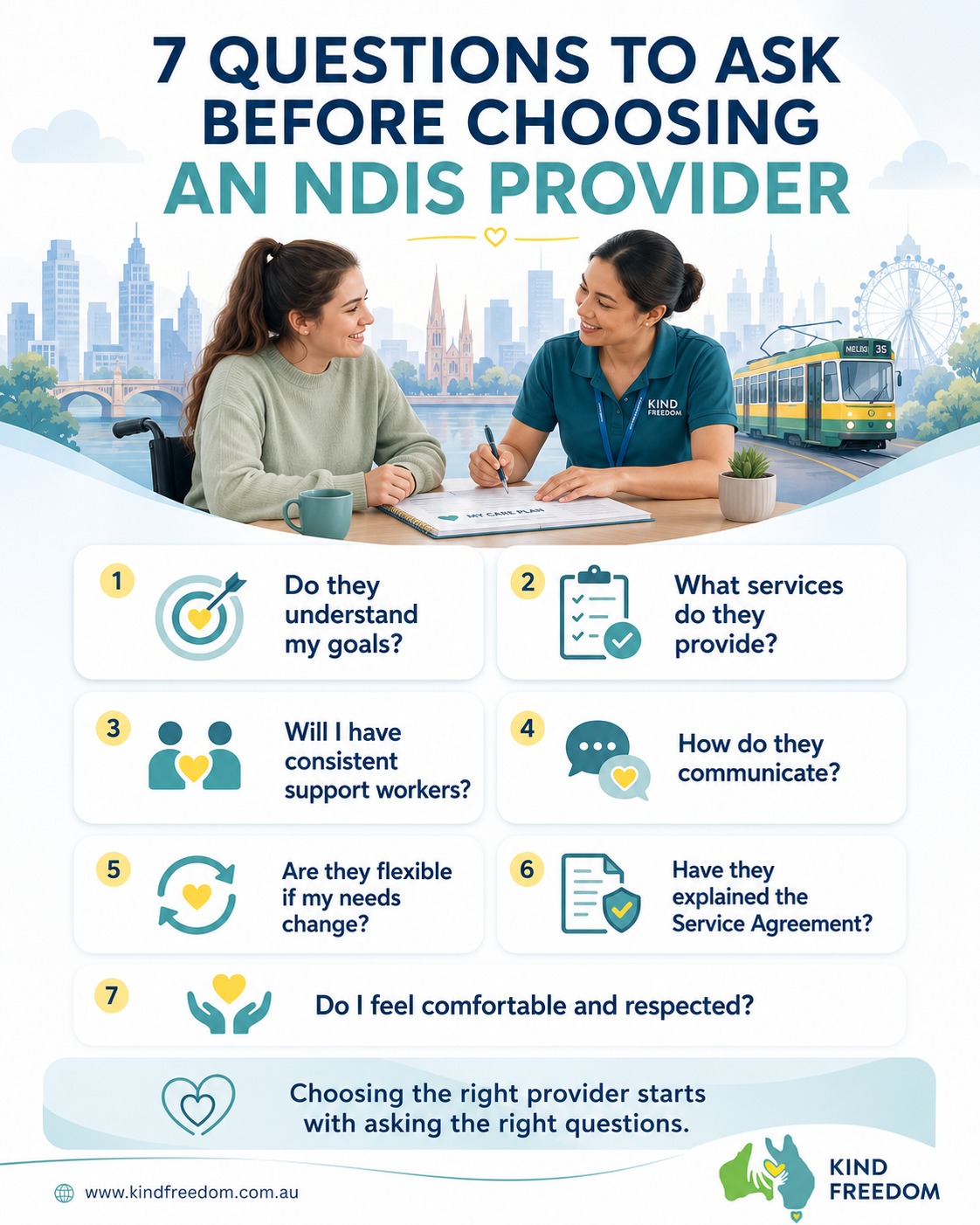
Questions to Ask Before Choosing an NDIS Provider
Meeting with a provider is an opportunity to learn whether they're the right fit for you.
Don't be afraid to ask questions. A professional provider will welcome the conversation.
Here are some useful questions to consider.
Question | Why It Matters |
What services do you provide? | Confirms they offer the support you need. |
Do you have experience supporting people with similar goals? | Helps you understand whether they're the right fit. |
Will I have the same support worker regularly? | Promotes consistency and stronger relationships. |
How quickly can support begin? | Helps you plan your services. |
How do you communicate with participants and families? | Sets expectations from the beginning. |
What happens if my support worker is unavailable? | Shows how they manage unexpected changes. |
Can my support change as my goals change? | Demonstrates flexibility. |
How often do you review participant goals? | Indicates whether they provide person-centred support. |
Compare Providers Before Making a Decision
Choosing the first provider you find may not always be the best approach.
Taking time to compare two or three providers allows you to make a more informed decision based on what matters most to you.
Consider comparing:
Feature | Provider A | Provider B | Provider C |
Services Offered | ✔ | ✔ | ✔ |
Experience Relevant to Your Needs | ✔ | ✔ | ✔ |
Consistent Support Workers | ✔ | ✔ | ✔ |
Communication | ✔ | ✔ | ✔ |
Flexible Scheduling | ✔ | ✔ | ✔ |
Service Agreement Explained Clearly | ✔ | ✔ | ✔ |
Local Melbourne Knowledge | ✔ | ✔ | ✔ |
Signs You've Found the Right Provider
Sometimes the decision comes down to how a provider makes you feel during your first conversation.
Positive signs include:
They listen more than they talk.
They ask about your goals instead of focusing only on your funding.
They explain things in simple, clear language.
They answer your questions honestly.
They respect your choices.
They don't pressure you into making a quick decision.
They explain your Service Agreement before asking you to sign it.
A provider who takes time to understand you is often more likely to deliver personalised support.
Red Flags to Watch Out For
Just as there are signs of a good provider, there are also warning signs that shouldn't be ignored.
Consider looking elsewhere if a provider:
doesn't explain their services clearly
is difficult to contact
takes a long time to respond to enquiries
avoids answering questions
frequently changes support workers without notice
pressures you to sign immediately
doesn't ask about your goals
provides unclear pricing or Service Agreements
Trust your instincts.
If something doesn't feel right during your first conversations, it's worth exploring other options before making a commitment.
Should You Meet a Provider Before Deciding?
Whenever possible, yes.
A phone call, video meeting, or face-to-face conversation can help you understand whether a provider is the right fit.
During your first meeting, pay attention to:
how well they listen
whether they understand your goals
if they explain services clearly
how comfortable you feel asking questions
whether you feel respected throughout the conversation
The relationship between a participant and provider is built on trust. Meeting beforehand can help you decide whether that relationship feels right.
Pro Tip:
Don't choose a provider based only on availability. The right provider should have the experience, communication style, and flexibility to support your goals over the long term. Taking an extra week to compare your options can lead to a much better experience throughout your NDIS journey.
Quick Self-Assessment Checklist
Before making your final decision, ask yourself these questions:
✔ Do I feel comfortable speaking with this provider?
✔ Do they understand my goals?
✔ Have they answered my questions clearly?
✔ Am I happy with how they communicate?
✔ Do I understand the Service Agreement?
✔ Do I know who will be supporting me?
✔ Can they adapt if my needs change?
If you answered "Yes" to most of these questions, you've likely found a provider worth considering.
Does a Registered or Unregistered Provider Matter?
One of the most common questions participants ask is whether they should choose a registered or unregistered NDIS provider.
The answer depends on how your NDIS plan is managed and what works best for your individual circumstances.
If you're NDIA-managed, you'll generally need to use registered NDIS providers.
If you're self-managed or plan-managed, you may have the flexibility to choose either a registered or an unregistered provider.
Rather than focusing only on registration status, it's important to consider the quality of support you'll receive.
A provider should have the skills, experience, and commitment to help you work towards your goals while respecting your choices and preferences.
Registered vs Unregistered NDIS Providers
Registered Provider | Unregistered Provider |
Approved by the NDIS Quality and Safeguards Commission. | Not registered with the Commission but may still provide quality support. |
Usually required for NDIA-managed participants. | Often available to self-managed and plan-managed participants. |
Must meet specific NDIS Practice Standards. | May offer greater flexibility depending on your circumstances. |
Regularly audited to maintain registration. | Should still demonstrate professionalism, experience, and reliable service. |
Experience Is More Important Than Size
Many people assume a large organisation automatically provides better support.
That's not always the case.
Some smaller providers offer highly personalised services because they spend more time getting to know each participant.
Instead of asking,
"How big is this organisation?"
ask,
"Will this provider understand my goals and support me consistently?"
A provider who knows your routine, communicates well, and genuinely values your independence can often provide a better experience than a larger organisation where support feels less personal.
How Do You Know if a Provider Is the Right Fit?
Finding the right provider isn't about ticking boxes on a checklist. It's about feeling confident that the people supporting you understand your goals and respect your choices.
After your first conversation, ask yourself:
Did they listen carefully?
Did they explain things clearly?
Did they ask about my goals?
Did I feel comfortable talking to them?
Did they answer my questions honestly?
Do I feel respected?
Can I imagine working with this team long-term?
Should You Read Reviews Before Choosing a Provider?
Yes, but don't rely on reviews alone.
Online reviews can give you an idea of other participants' experiences, but they shouldn't be the only reason you choose a provider.
Instead, use reviews as one part of your research.
Look for consistent feedback about:
communication
reliability
professionalism
respectful support
punctuality
responsiveness
Remember that everyone's experience is different. A conversation with the provider is still one of the best ways to decide whether they're the right fit for you.
Common Mistakes to Avoid
Choosing an NDIS provider is an important decision, and a few simple mistakes can make it harder to receive the support you're looking for.
Being aware of these common issues can help you make a more informed choice.
Choosing the First Provider You Find
It's natural to want to arrange support quickly, especially if you've recently received your NDIS plan.
However, choosing the first provider without comparing your options may mean missing out on a provider that's a better fit.
Speaking with two or three providers gives you a clearer understanding of what's available.
Focusing Only on Price
NDIS pricing is generally guided by the NDIS Pricing Arrangements and Price Limits.
Instead of looking only at cost, think about the value a provider offers.
Consider:
communication
reliability
experience
flexibility
consistency of support
participant satisfaction
Quality support often has a greater impact than choosing a provider based on price alone.
Not Reading the Service Agreement
Your Service Agreement explains how your support will be delivered.
Before signing, make sure you understand:
the services included
cancellation policy
notice periods
responsibilities of both parties
pricing arrangements
If anything isn't clear, ask questions before agreeing to the terms.
Ignoring Communication
Good communication is essential.
If it's difficult to get answers before services begin, it's worth considering how communication may work once you're receiving regular support.
Choose a provider who keeps you informed and responds to your questions in a timely and respectful way.
Forgetting About Future Goals
Your needs may change over time.
A provider should be able to adapt their support as your goals develop.
Choosing someone who offers flexible, person-centred support can reduce the need to change providers later.
Questions Families Often Ask
Family members often help participants compare providers and make important decisions.
These are some common questions worth discussing together.
Will my family be involved in planning my support?
If you want them to be, many providers encourage families, carers, and other important people in your support network to be involved in planning and reviewing your support.
Can I request a different support worker?
Yes. If you feel another support worker would better suit your needs or communication style, you can usually discuss this with your provider.
Open communication helps providers understand what's working well and where changes may be needed.
What happens if my needs change?
A good provider understands that goals and circumstances don't stay the same forever.
As your needs change, your support should be reviewed and adjusted to continue helping you achieve the outcomes that matter most.
Why a Person-Centred Approach Matters
The best NDIS providers don't simply deliver services—they work alongside participants to create supports that reflect their individual goals, preferences, and choices.
This is known as a person-centred approach.
Rather than treating every participant the same, a person-centred provider takes time to understand:
your strengths
your interests
your routines
your communication preferences
the goals that are important to you
This approach helps create supports that feel meaningful, practical, and tailored to your everyday life.
During your first meeting, notice how many questions the provider asks about you. A provider who is genuinely interested in understanding your goals, preferences, and daily routine is more likely to deliver personalized support than one who spends most of the meeting talking about their own services.
Choosing a Provider Is About More Than Services
The right NDIS provider should help you feel confident, respected, and supported, not just during your first meeting, but throughout your entire NDIS journey.
When comparing providers, look beyond the list of services they offer.
Think about the experience they provide, the relationships they build, and their willingness to work with you as your needs change.
A provider who values communication, consistency, and person-centred support can make a meaningful difference in helping you achieve your goals.
Conclusion
Choosing an NDIS provider is about more than arranging support services. It's about finding people who will work alongside you, respect your choices, and help you achieve the goals that matter most.
Taking the time to compare providers, ask thoughtful questions, and understand how they deliver support can make a significant difference to your overall experience.
Remember, there isn't one provider that's right for everyone.
The best provider is the one who listens to your needs, communicates openly, and provides personalised support that helps you build confidence, independence, and a better quality of life.
Making an informed decision today can help create a more positive and rewarding NDIS journey for years to come.
Looking for an NDIS Provider in Melbourne?
At Kind Freedom, we believe quality support starts with understanding the person behind the NDIS plan.
Our team takes the time to learn about your goals, preferences, and daily routines so we can provide support that's personalised, respectful, and focused on helping you achieve greater independence.
Whether you're new to the NDIS or considering a different provider, we're here to answer your questions and help you explore your options.
Contact Kind Freedom today to learn how our team can support your journey with confidence.
Written by
Edson Rushenya
Kind Freedom Australia blogger.