

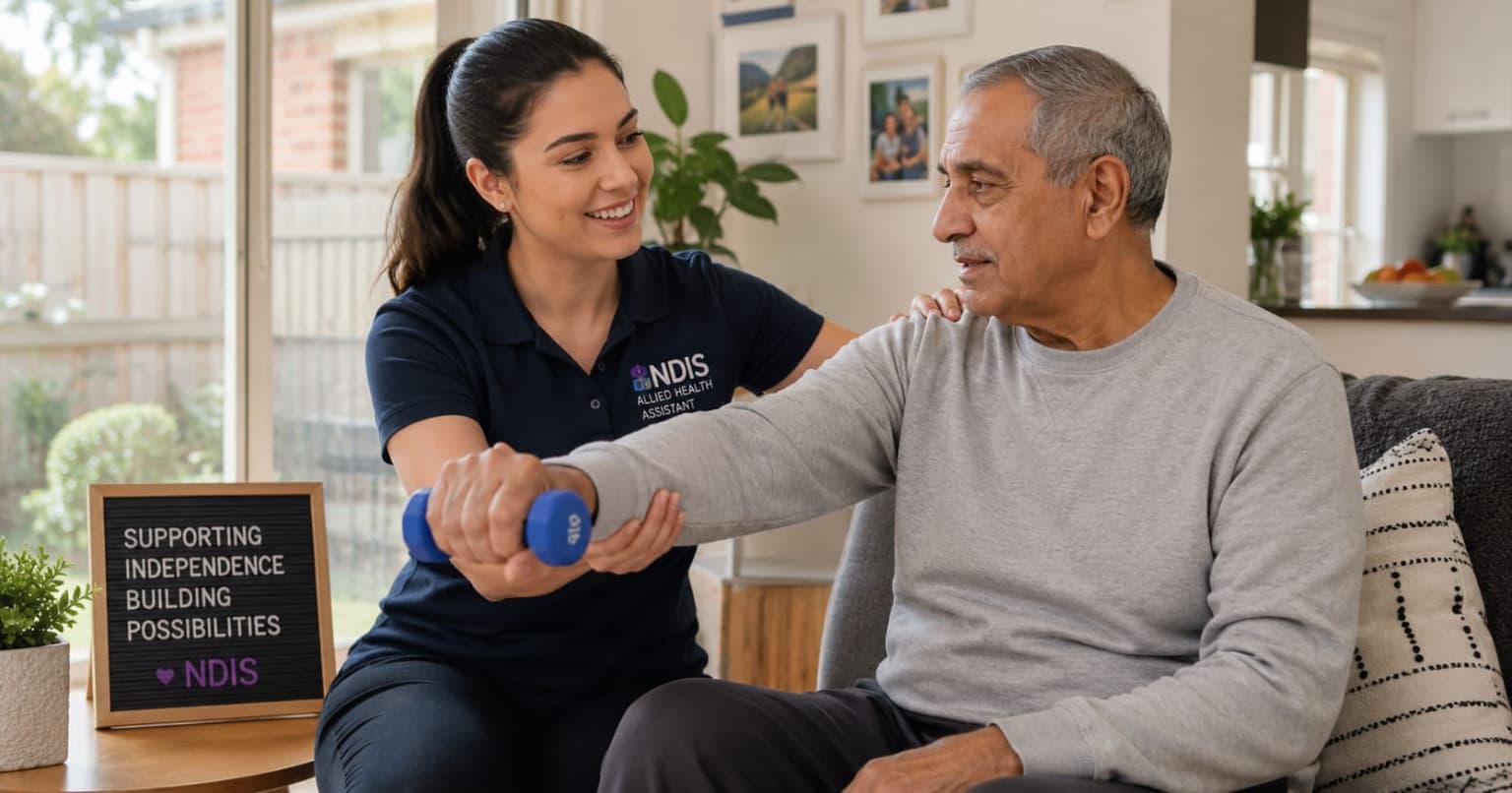
After a stroke left David unable to dress or cook independently, Kind Freedom's home-based AHA sessions helped him rebuild arm function and reclaim his daily routine.
Overview
Participant
David
Senior (65+)
Location
Sunshine, Western Melbourne
Support duration
6 months
Support needs
The Challenge
Background
David was 58 when he had an ischaemic stroke in early 2025. The stroke affected the left hemisphere of his brain and left him with significant weakness in his right arm and hand , his dominant side.
Before the stroke, David lived alone in Sunshine and managed his own life without support. He worked casually, drove himself around, cooked his own meals, and maintained his home. The stroke changed everything in the space of a single morning.
He was discharged from hospital after six days with a referral to community physiotherapy. The waitlist stretched past three months. In that gap, his daughter began coming over daily to help with dressing, meal preparation, and personal care , a situation that neither of them had prepared for and both found hard.
David's GP supported his NDIS access request, and he was approved as a self-managed participant with Capacity Building funding under Improved Daily Living Skills (Category 15). He was referred to Kind Freedom through his support coordinator and started sessions within two weeks of approval.
Name and identifying details have been changed to protect participant privacy. Published with consent.
Goals
David's NDIS plan centred on three goals his support coordinator helped him articulate:
- Restore functional strength and fine motor control in the right arm for everyday tasks
- Return to preparing his own meals without assistance
- Reduce the hours his daughter was spending providing informal daily care
These goals were practical, specific, and grounded in what David had lost. He wasn't looking for dramatic recovery , he wanted his mornings back.
Challenges
The period between hospital discharge and the start of consistent community therapy is one of the most important , and most commonly wasted , windows in stroke recovery. Without structured input during this time, gains made in hospital can stall or reverse.
For David, three barriers shaped the early months:
The first was the therapy gap. Community physiotherapy wasn't available for more than three months after discharge. Without consistent input in that window, David's right arm function plateaued well below what it had been.
The second was confidence. Alongside the physical limitation came a withdrawal from attempting things. David had started assuming he couldn't do tasks before he'd even tried — a common pattern after stroke that, left unchallenged, becomes its own obstacle.
The third was informal carer load. His daughter was providing around two hours of support each day. She was doing it willingly, but it was affecting her own work and household, and David found it difficult to accept. The informal arrangement needed to be replaced by structured support , not just for David, but for her.
How We Helped
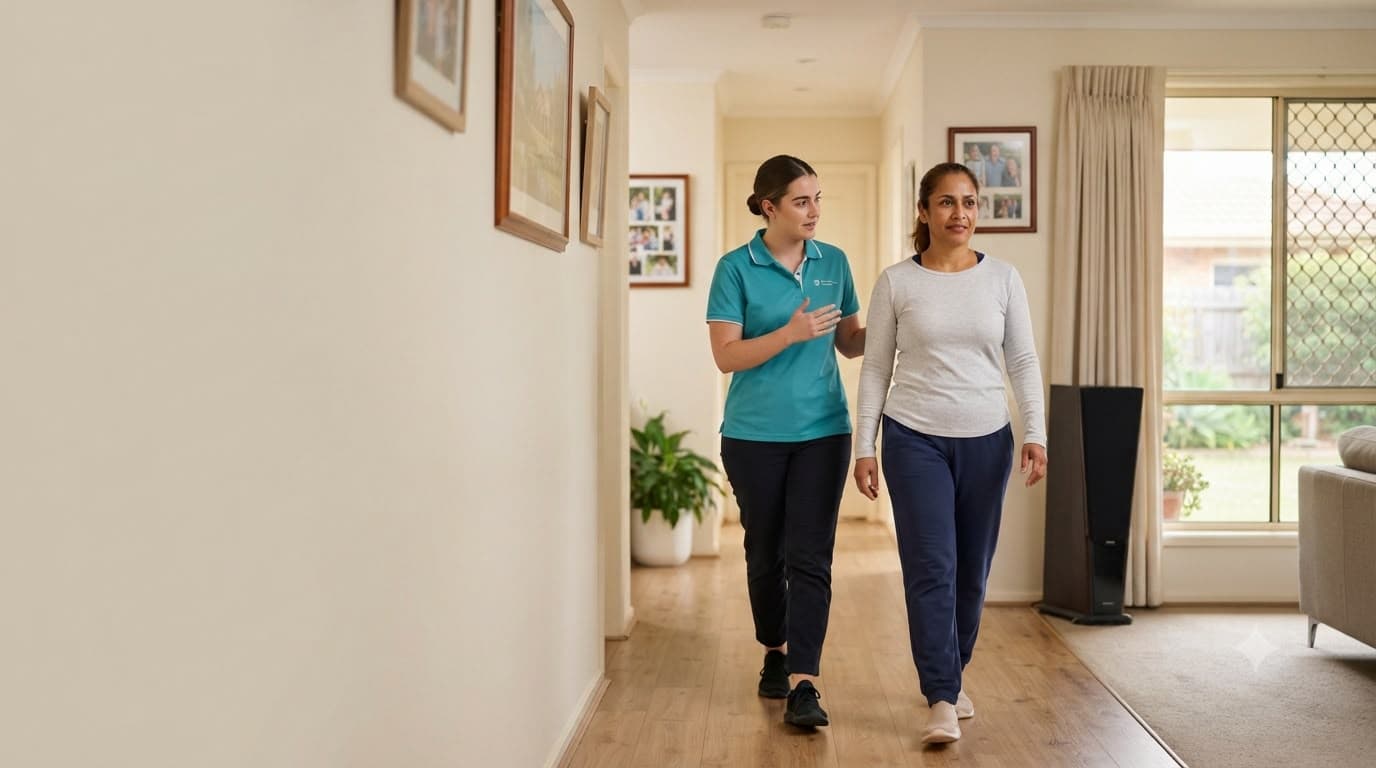
Kind Freedom provided allied health assistant (AHA) sessions three times per week, with each session running 45 minutes and delivered in David's home in Sunshine.
The programme was designed and clinically supervised by a registered physiotherapist, who assessed David's baseline function at the outset and created an individualised exercise programme targeting right arm strength, range of movement, and fine motor control. The physiotherapist reviewed David's session notes fortnightly and adjusted the programme at each review as his capacity changed.
Sessions followed a consistent structure: warm-up movements, targeted strengthening and mobility work, task-specific functional practice (buttons, cutlery, kitchen tasks, personal care activities), and a cool-down. Kind Freedom's AHA , Certificate IV qualified , completed detailed session notes after every visit and communicated directly with the supervising physiotherapist between formal review points.
This model , qualified AHA delivering the programme, registered clinician retaining clinical oversight , meant David received consistent, structured therapy at a frequency that would not have been sustainable using a registered allied health professional alone.
NDIS funding used: Category: Capacity Building , Improved Daily Living Skills (Category 15) Support item: Therapy Assistant (Level 1) Item code: 15_052_0128_1_3 Price limit (2025–26 standard rate): $56.16/hr
Results Achieved
72
Sessions delivered
3
Daily living goals achieved
75%
Label: Reduction in daily carer hours
✓
Label: NDIS plan renewed at review
Six months of consistent, structured support produced measurable change across all three of David's NDIS goals.
By month three, David had regained enough fine motor control to button his own shirt without assistance. It had been a specific goal he raised in his first session , one that had seemed distant at the time. Achieving it shifted something in his confidence as well as his function.
By month four, he was preparing simple meals on his own: eggs, sandwiches, reheating leftovers. The kitchen, which had felt off-limits since the stroke, became part of his daily routine again. By month six, he was cooking full meals twice a week.
His daughter's involvement dropped from around two hours of hands-on support each day to a brief phone check-in. The care arrangement that had developed out of necessity in the months after the stroke was no longer needed at the same intensity.
At David's NDIS plan review in the third quarter of 2025, his Capacity Building funding was continued. The plan reviewer noted the measurable progress against goals and the clinical rationale for ongoing support to build on the gains already achieved.
Participant Feedback
“"I thought my independence was gone for good. These sessions gave me my mornings back , I can make my own breakfast now, which sounds like a small thing, but when you couldn't do it for months, it doesn't feel small at all."”
— David, participant , Sunshine, Western Melbourne
David's situation is not unusual. The gap between hospital discharge and consistent community therapy is one of the most common gaps NDIS participants face after a stroke or neurological event , and it is one of the most consequential. If you or someone you support is in that position right now , functional ability declining, informal carers stretched, a waitlist that keeps moving , structured AHA support can bridge that gap. The earlier it starts, the more there is to build on.
About Kind Freedom
Kind Freedom is an unregistered NDIS provider based in Melbourne's western suburbs, delivering allied health assistant and daily living support to self-managed and plan-managed participants.
Our allied health assistants hold a Certificate IV in Allied Health Assistance and work under the clinical supervision of registered health professionals , including physiotherapists and occupational therapists , to deliver structured, goal-focused therapy programmes in participants' homes and communities.
We work with participants living with neurological conditions, acquired disability, and age-related functional decline across Sunshine, Footscray, Werribee, Hoppers Crossing, and surrounding areas.
If you or someone you support has experienced a stroke and is looking for consistent, home-based NDIS therapy support, we'd welcome the conversation.
→ Learn about our Allied Health Assistant service
→ Talk to our team: kindfreedom.com.au/contact/
→ Call us directly: 0405 458 852
→ Get in touch with Kind Freedom