

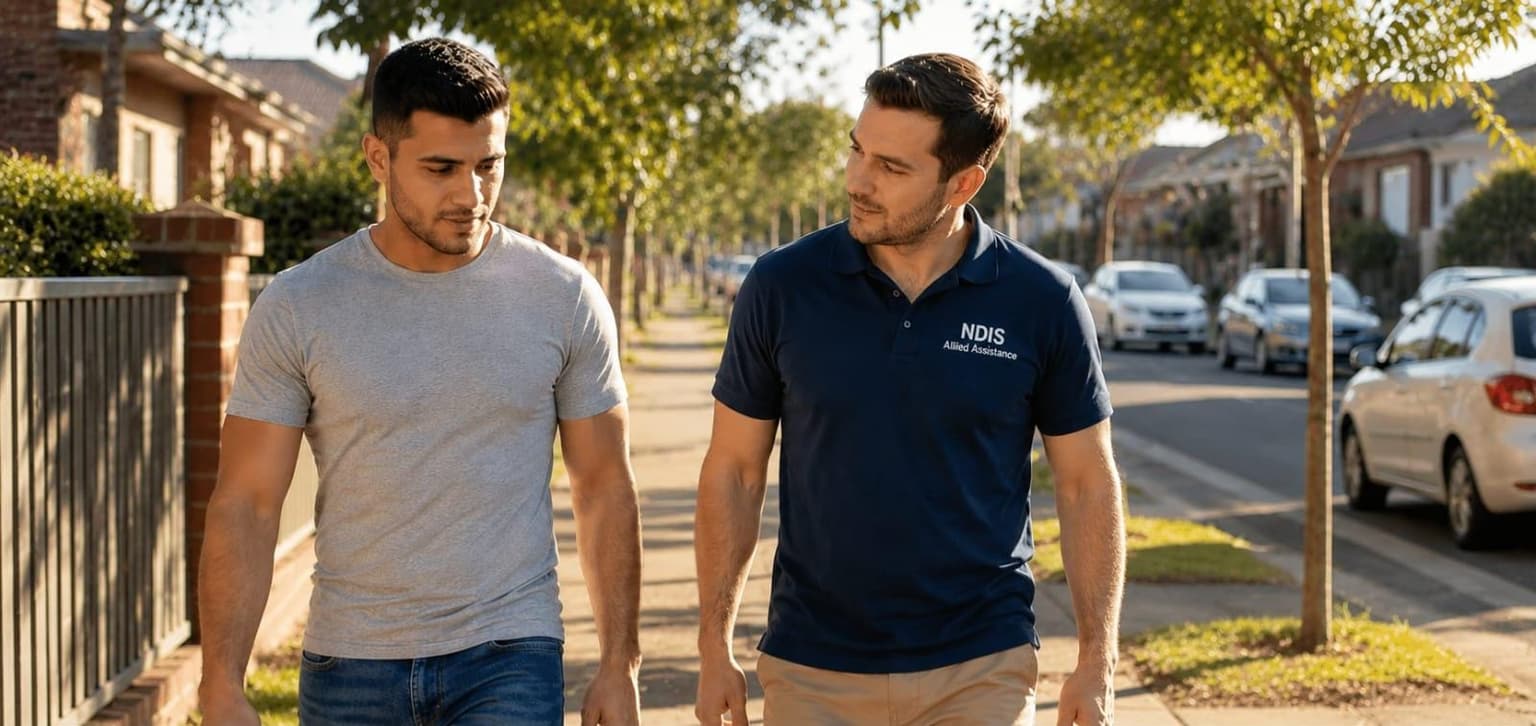
At 24, Marcus had a career, a shared house, and his independence. A car accident took all three. Two years later, Kind Freedom's NDIS support helped him start getting them back.
Overview
Participant
Marcus
Adult (18–64)
Location
Werribee, Western Melbourne
Support duration
10 months (ongoing)
Support needs
The Challenge
Background
Marcus was 24 when the accident happened. He was driving home from a job site on a Friday evening in autumn when another vehicle ran a red light. He spent three weeks in a neurological ward. The traumatic brain injury he sustained affected his memory, his processing speed, his word-finding, and the left side of his body , particularly his arm and hand.
Before the accident, Marcus had been two years into an electrical apprenticeship. He lived in a share house in Hoppers Crossing with two mates from his TAFE cohort. He played football on Saturdays. He was, by every measure, a young man building his own life.
After the accident, he moved back into his parents' home in Werribee. His apprenticeship could not be held for him indefinitely. His housemates found someone else. His football team played on without him. The friends who visited in the early months gradually visited less, in the way that people do when recovery takes longer than anyone expected.
His parents , his father works in logistics, his mother is a teacher's aide , restructured their lives around him. His father began taking him to medical appointments and therapy sessions on his rostered days off. His mother reorganised her shifts to be home by the time Marcus woke up, because the mornings were the hardest. Neither of them described this as a burden. But it was.
Marcus was approved for the NDIS twelve months after the accident, with a plan-managed plan that included Capacity Building and Core Supports. His occupational therapist referred him to Kind Freedom. He had been on the waiting list of another provider for four months and had not heard back.
Goals
Marcus had three goals when he began with Kind Freedom, and he articulated them himself with very little prompting.
- Build enough cognitive and physical function to live independently, or semi-independently, again
- Re-engage with structured activity outside the home work, volunteering, or sport , anything that was not his parents' living room
- Develop practical strategies to manage the daily effects of the brain injury: memory lapses, fatigue, word-finding difficulties, and left-hand coordination
There was something underneath all three goals that he did not say directly but that shaped every session: he wanted to feel like himself again. Not the person he had been before the accident he understood, mostly, that that was not the target. But a version of himself he could recognise.
Challenges
The hardest thing about an acquired brain injury is that it is invisible.
Marcus looked, to anyone who did not know him, like a healthy young man. He walked without aids. He held conversations. He could tell you what year it was and who the Prime Minister was. What he could not always do was remember whether he had taken his medication, or follow the thread of a complex instruction, or get through an afternoon without his left hand failing him mid-task. The gap between how he appeared and how he was actually functioning created its own set of difficulties with services, with people who knew him before, and with himself.
He had stopped telling people the extent of it. It was easier.
Three things shaped the early months of the programme in particular ways.
The first was the nonlinear nature of recovery. A good week could be followed by a bad one with no clear trigger. Marcus would make progress on a skill — sequencing a cooking task, managing a morning routine independently and then lose access to it for a week after a difficult night's sleep or a period of high sensory stimulation. This was normal for ABI recovery. It did not feel normal. It felt like going backwards, repeatedly.
The second was grief. Not spoken grief Marcus was not someone who used that word about himself but the quiet, persistent awareness of what he had been capable of before. He had been competent. He had been building something. The contrast between that version of himself and the one sitting in his parents' spare room at 26 was not something two hours of therapy per week could simply resolve.
The third was his parents. They were doing too much. Not because they wanted to, but because there had been no structured support in place to do it instead. His father had accrued more than two weeks of untaken leave managing Marcus's appointments. His mother was tired in a way she was careful not to show. The situation needed more than what a family could sustain.
How We Helped
Kind Freedom provided two types of support running in parallel across the week.
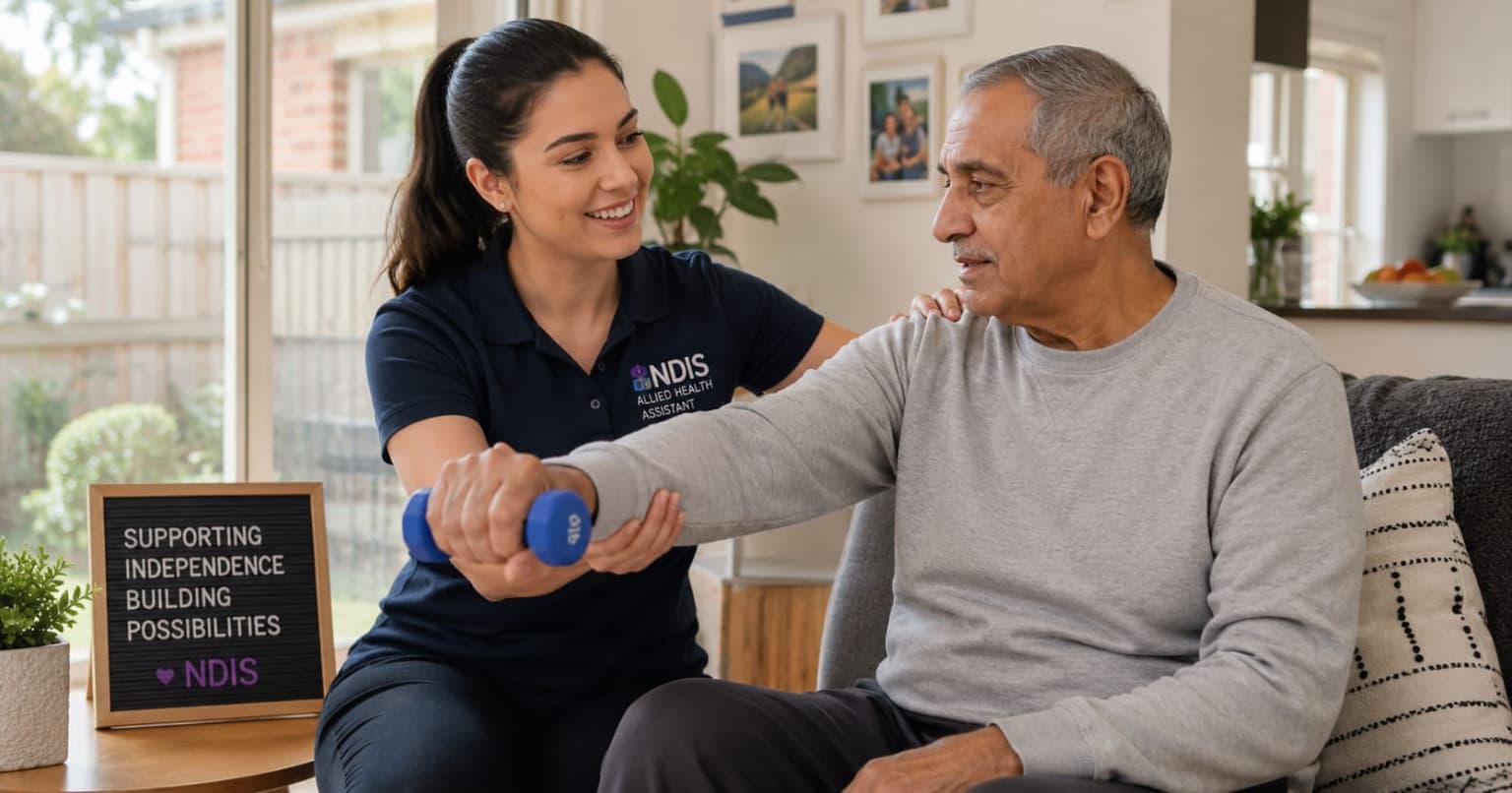
The first was allied health assistant sessions, twice a week, each running 60 minutes and delivered at Marcus's home in Werribee. These sessions were designed and supervised by a registered occupational therapist who assessed Marcus's baseline cognitive and physical function at the outset, then built an individualised programme targeting left-hand coordination, sequencing skills, fatigue management, and the use of practical memory compensation strategies things like structured daily planners, phone-based reminders, and step-by-step visual guides for tasks he found difficult to sequence independently.
The OT reviewed session notes every fortnight and adjusted the programme as Marcus's function changed sometimes progressing, sometimes recalibrating after a difficult stretch. The AHA attended every session, tracked Marcus's engagement and effort carefully, and maintained detailed notes that went directly to the supervising OT.
The second stream was daily living support a support worker attending three mornings per week to assist Marcus with the structured tasks that his parents had been carrying: medication management, preparing breakfast, organising the week ahead. This was not dependency-building support. It was designed from the beginning to reduce what Marcus needed prompting for, session by session, until the prompting was no longer necessary.
Both streams were coordinated deliberately. The OT's cognitive strategies were reinforced during the daily living sessions. What was practised in AHA appointments was applied in real morning routines the following day. The two services spoke to each other.
NDIS funding used: Capacity Building Improved Daily Living Skills (Category 15) Support item: Therapy Assistant (Level 1) AHA sessions Item code: 15_052_0128_1_3 Price limit (2025–26 standard rate): $56.16/hr
Core Supports Assistance with Daily Life (Category 1) Support type: Support Worker daily living assistance Plan type: Plan-Managed
Results Achieved
80+
AHA and Support Sessions Completed
3 → 1
Morning Support Sessions Reduced Per Week
2 days
Weekly Volunteering Secured
2 yrs
Of Family Carrying Alone — Now Shared
Ten months in, Marcus is not where he was before the accident. He will tell you that himself, without bitterness he has made his peace with that being the wrong target. What he is, is further than he was. Considerably.
By month three, he was managing his morning routine without his mother needing to be in the house to start it. Medication, breakfast, a review of the day's plan he was doing it from the visual system the AHA and OT had built with him, and it was working. His mother returned to her original shift pattern for the first time in nearly two years.
By month five, the daily living support worker had stepped back from three mornings to two. By month eight, to one. The support was still there, but Marcus was no longer dependent on it to get through the morning.
In month six, he began volunteering two days a week at a community garden in Werribee. It was physical, structured, and quiet. He described it as the first place since the accident where he felt useful. He has not missed a session.
His left hand is not what it was. Some things it may never fully return to. But his fine motor control has improved enough that he can manage most daily tasks without compensation strategies, and his word-finding the thing that had frustrated him most in conversation has become noticeably less effortful over the course of the programme.
His father took three days of annual leave in the last quarter. The first time since the accident that he had taken leave for himself.
Marcus has begun conversations with his plan manager about a supported pathway back to part-time work in a different field to electrical work, one that is kinder to his current capacity. That conversation was not on the table twelve months ago.
Participant Feedback
“Marcus's quote: "I used to think the goal was to get back to who I was before. It took a while to realise that was the wrong goal. The right goal was just forward. These sessions gave me forward." His father's quote: "We were holding everything together because there was nothing else. When Kind Freedom came in, it was the first time in almost two years that I felt like I didn't have to be everywhere at once. That sounds small. It wasn't small."”
— Marcus (age 26) and his father — Werribee, Western Melbourne
For Anyone Navigating Life After a Brain Injury
Recovery from an acquired brain injury does not follow a straight line. There will be weeks that feel like progress and weeks that feel like the opposite. Both are part of the same process. What makes the difference, consistently, is having the right structured support in place during that process not support that does things for you, but support that works with you, week by week, toward independence you have defined for yourself.
If you or someone in your family is living with the effects of an acquired brain injury and trying to work out what NDIS support should look like, we are glad to have that conversation.
Kind Freedom provides allied health assistant sessions under registered OT and physiotherapy supervision, alongside daily living assistance and life skills support, across Werribee, Hoppers Crossing, Sunshine, Footscray, and surrounding suburbs in Melbourne's west. We work with plan-managed and self-managed NDIS participants. Referrals from support coordinators, hospitals, and rehabilitation teams are welcome.
There is no waitlist. No standard package. Just an honest conversation about what you need.
→ Learn more about our Allied Health Assistant service: kindfreedom.com.au/services/allied-health-assistant/
→ Talk to our team: kindfreedom.com.au/contact/
→ Call us directly: 0405 458 852