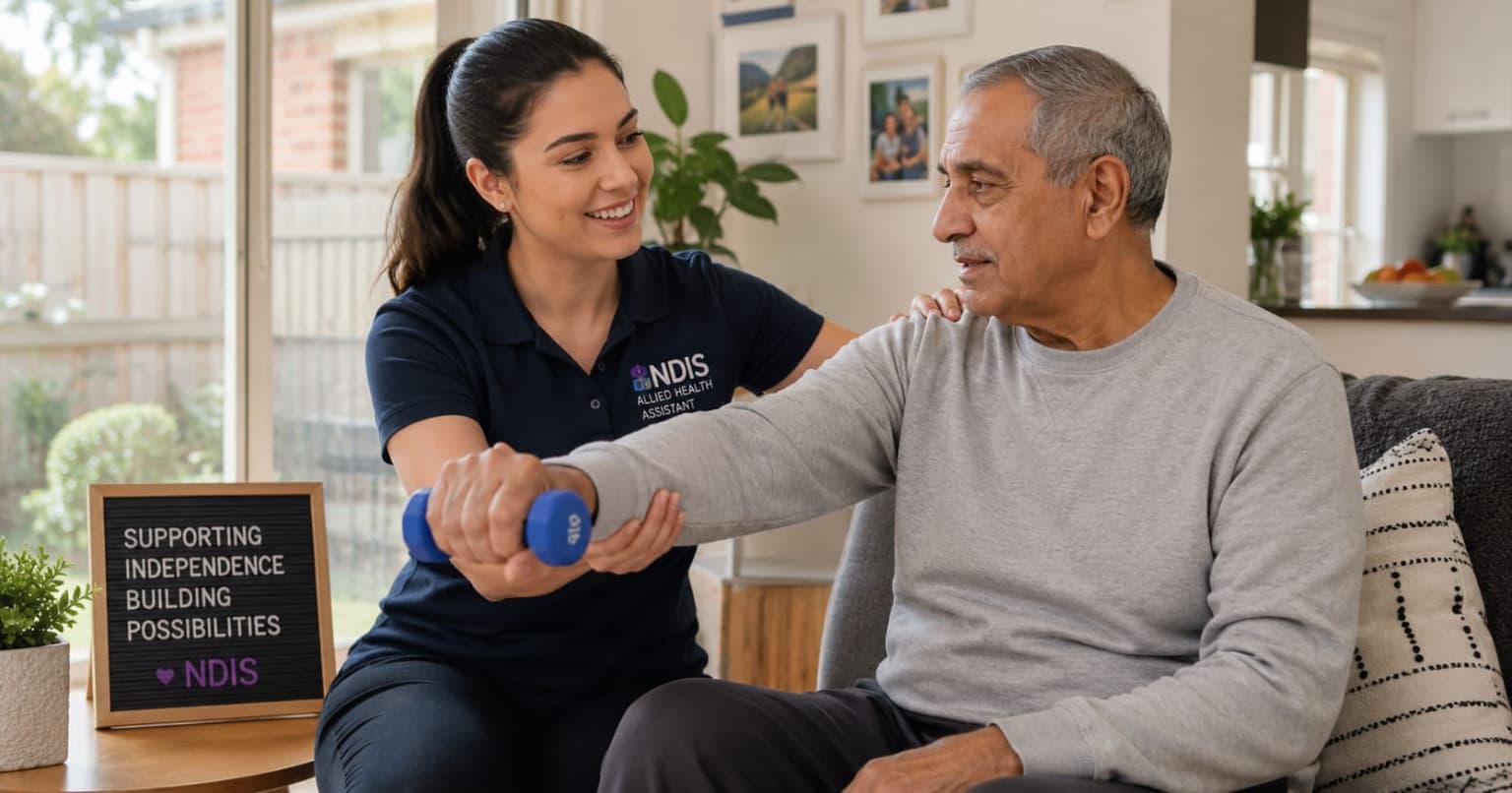


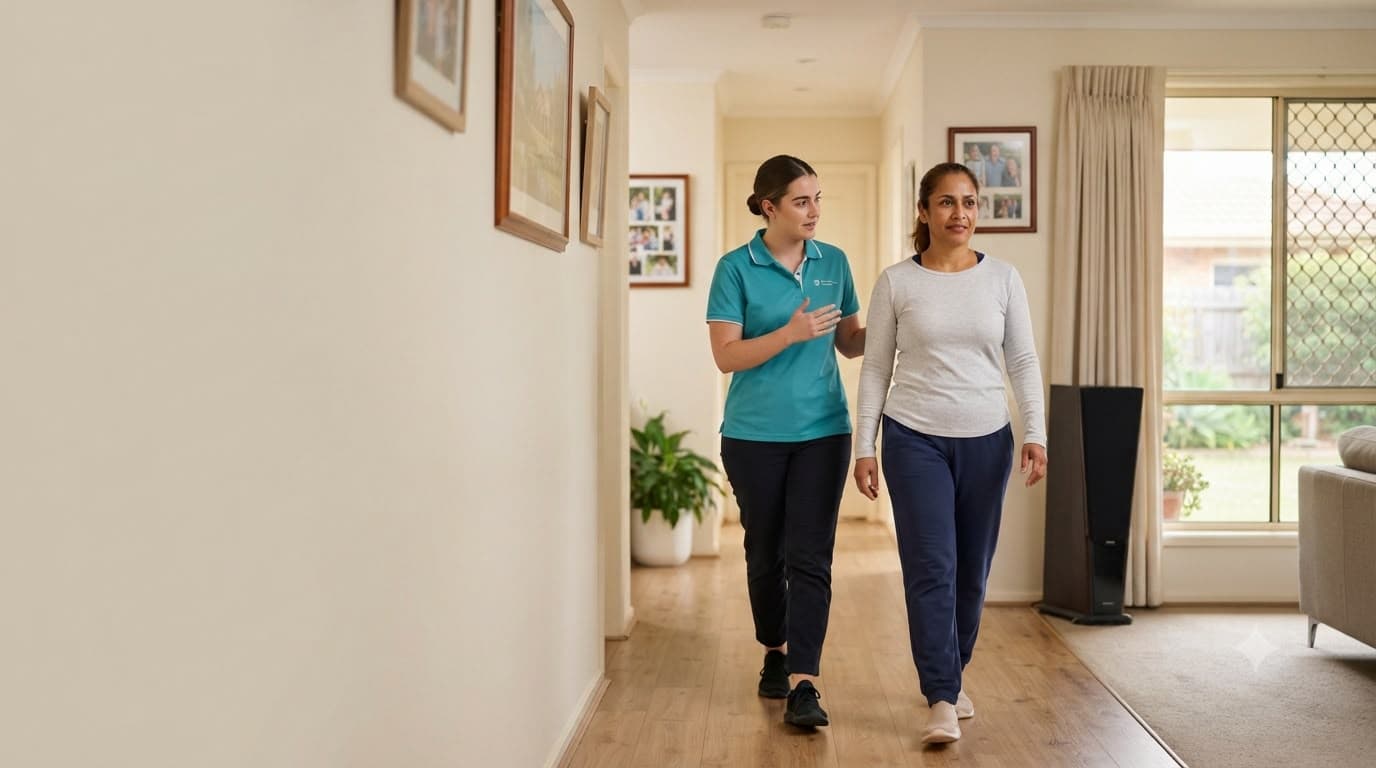
After a relapse left Sarah struggling to manage daily life, Kind Freedom's NDIS-funded AHA sessions helped her get back to cooking, walking, and being present for her kids.
Overview
Participant
Sarah
Adult (18–64)
Location
Footscray, Western Melbourne
Support duration
9 months (ongoing)
Support needs
The Challenge
Background
Sarah was 44 when her most recent relapse brought her daily life to a near halt. She had been living with relapsing-remitting MS for six years long enough to know the cycle. A flare, a difficult stretch, then a gradual return to something close to normal. This relapse was different.
The effects on her balance and left leg coordination were more pronounced than previous episodes, and the fatigue that followed sat heavier than anything she had managed before. She lives in Footscray with her two teenage children and works part-time as an office administrator. Before the relapse, she had kept her condition largely in check attending regular physiotherapy and adjusting her work hours when she needed to. After it, the day-to-day picture shifted in ways that were hard to ignore.
She cut her work hours back further. The walk to the local shops, a 1.2km round trip she had been doing every day stopped. Her teenagers quietly took over the cooking and most of the household tasks. Nobody had asked them to. They just did it, and that bothered Sarah more than she expected.
Her neurologist had referred her to the NDIS two years earlier, and she was already plan-managed, with Capacity Building and Core Supports funding in place. After the relapse, her support coordinator worked with her to access Capacity Building at a higher session frequency. Kind Freedom was recommended through her coordinator, and sessions began within three weeks of the referral.
Name and identifying details have been changed to protect participant privacy. Published with consent.
Goals
Sarah's physiotherapist and support coordinator helped her articulate three goals for the AHA programme:
- Rebuild walking tolerance and reduce the daily impact of fatigue on her capacity to function
- Return to preparing meals for her family independently, most nights of the week
- Build enough stamina and confidence to re-engage with activities outside the home
The third goal was the one she came back to most in the early weeks of the programme. She wanted to attend her daughter's end-of-year school concert an event she had missed the year before. That became a quiet reference point throughout the nine months that followed.
Challenges
MS fatigue is not like ordinary tiredness. It does not lift after a good night's sleep, and it leaves no visible trace. Sarah had spent years explaining this to people who looked at her and saw someone who seemed fine. After the relapse, the gap between how she looked and how she actually felt had widened considerably.
Three things were working against her when she started with Kind Freedom.
The first was the severity of the fatigue itself. At the height of the relapse, Sarah needed to rest for two or more hours every afternoon just to manage the evening. That left a narrow window for cooking, for being present with her kids, for doing anything at all. Trying to push through that window too hard would bring on worse fatigue the following day. She had learned that lesson more than once.
The second was the reluctance to push at all. One of the less-discussed effects of living with a relapsing condition is what happens to your relationship with effort. When you have learned that overdoing things carries consequences, you start pulling back — even when some measured effort is exactly what your body needs. Sarah was conscious of this in herself. She had been holding back from things that might actually have helped her.
The third was what was happening at home. Her teenagers had stepped up without being asked, and in doing so had quietly taken on a version of adult responsibility that was not theirs to carry. Sarah found it distressing to watch. It fed into her mood and, through that, into her energy. The practical problem had been solved and an emotional one had opened up in its place.
How We Helped
Kind Freedom provided allied health assistant sessions twice a week, with each session running 50 minutes, delivered in Sarah's home in Footscray.
The programme was designed by a registered physiotherapist with experience in neurological conditions. At the first session, the physiotherapist carried out a baseline assessment covering Sarah's gait pattern, left-side coordination, functional balance, and fatigue profile including when in the day her energy was best and what activities triggered the sharpest drop. The programme was built around those findings.
Sessions were structured around three areas. The first was balance and gait training, targeting the specific left-side coordination deficit that had emerged from the relapse. The second was a graduated exercise carefully dosed movement that built walking tolerance without pushing past the threshold that would trigger a fatigue flare. The third was energy conservation: practical strategies for managing Sarah's daily energy across the household so that what she had went further.
Kind Freedom's AHA held a Certificate IV in Allied Health Assistance. She completed session notes after every visit, which went directly to the supervising physiotherapist for fortnightly review. The physiotherapist adjusted the programme at each review point sometimes increasing load as Sarah's tolerance improved, sometimes pulling back after a difficult week. This was not a set-and-forget programme. It was responsive.
Sarah also received support under Core Supports for personal care on mornings following heavier sessions, giving her the space to engage fully in the AHA programme without managing everything herself.
NDIS funding used: Category: Capacity Building Improved Daily Living Skills (Category 15) Support item: Therapy Assistant (Level 1) Item code: 15_052_0128_1_3 Price limit (2025–26 standard rate): $56.16/hr
Results Achieved
72
AHA Sessions Completed
50%
Reduction in Daily Rest Time
4 nights
Cooking Independently Each Week
3
Mobility Goals Achieved at Plan Review
Nine months into the programme, Sarah's progress was not the kind that announces itself. MS rarely works that way. The changes were specific, incremental, and grounded in the things that had actually mattered to her from the beginning.
By month three, she was walking to the local shops and back, the 1.2km she had given up. She did it slowly, and she rested when she got home, but she was doing it. The threshold that had felt out of reach in the early weeks had become a manageable part of her week.
By month five, her daily afternoon rest had reduced from over two hours to under an hour on most days. The window in her day had widened. Not dramatically, but enough.
By month six, Sarah was cooking dinner four nights a week. Her teenagers still helped on the other three and she was glad of it, she said but the balance had shifted. They were helping. They were no longer carrying.
Her daughter's end-of-year school concert was in month eight. Sarah attended. She had missed the year before.
At her NDIS plan review in early 2026, Capacity Building funding was continued and the AHA session frequency was maintained, with a six-month review built into the plan.
Participant Feedback
“"The hardest part of MS isn't the relapse. It's watching your life get smaller and telling yourself that's just how it is now. What these sessions gave me wasn't a cure. They gave me back the small things, cooking dinner for my kids, walking to the shops, being at my daughter's concert. That's what independence actually looks like."”
— Sarah, participant — Footscray, Western Melbourne
Is This Your Situation Too?
MS presents differently for everyone, but one thing tends to stay consistent: the period after a relapse matters. The longer functional losses go unaddressed, the harder they are to rebuild. Structured clinical therapy during and after a relapse is not optional it is what determines how much you get back.
NDIS Capacity Building funding under Category 15 covers allied health assistant sessions. If your plan includes this category, you may be able to access higher-frequency therapy support than you have been getting through clinic-based sessions alone. If you are not sure what your plan includes, that is something we can help you work through.
Kind Freedom provides AHA sessions under registered clinician supervision across Footscray, Sunshine, Werribee, Hoppers Crossing, and surrounding suburbs in Melbourne's west. We work with participants living with MS, Parkinson's disease, stroke, acquired brain injury, and other neurological conditions. Self-managed and plan-managed participants only.
There are no waitlists. No packages. Just a conversation about what you need.
→ Learn more about our Allied Health Assistant service: kindfreedom.com.au/services/allied-health-assistant/
→ Talk to our team: kindfreedom.com.au/contact/
→ Call us directly: 0405 458 852