


Robert spent fifty years fixing things. Parkinson's was the one thing he couldn't fix. With Kind Freedom's NDIS support, he found a different way to stay in control.
Overview
Participant
Robert
Senior (65+)
Location
Hoppers Crossing, Western Melbourne
Support duration
9 months (ongoing)
Support needs
The Challenge
Background
Robert spent his working life as a structural engineer. For forty-three years he assessed loads, identified tolerances, and solved problems that other people could not see coming. He built his own home extension in 1994 with two mates and a hired concrete mixer. He serviced his own cars until the year he turned sixty-eight. He is not someone who has ever asked for help easily.
He is seventy-one now, and he has Parkinson's disease.
The diagnosis came three years ago, during a routine check with his GP after Helen his wife of forty-four years noticed that his right hand had developed a faint, persistent tremor. He had noticed it too. He had decided not to mention it.
The condition has progressed at a moderate pace. The tremor in his right hand is more pronounced now. His gait has been affected Parkinson's causes a characteristic shortening of the stride and, in Robert's case, episodes of freezing, where his legs simply stop responding mid-step and he cannot restart without a cue or a prompt. His voice has softened in a way that people who don't know him well sometimes mistake for shyness. He has also had two falls in the past two years, both in the bathroom, both when Helen was in another part of the house.
The falls frightened Helen far more than they frightened Robert. She stopped sleeping soundly. She began accompanying him to places she had never accompanied him before. She quietly gave up her Monday book club because she did not want to be forty-five minutes away if something happened. She did not tell him that was why.
Eight months ago, Robert had to surrender his driver's licence. His neurologist had flagged reaction time concerns. Robert describes this as the hardest thing that has happened to him since the diagnosis not the tremor, not the freezing, not the falls. The licence. He had driven himself everywhere for fifty-three years.
Helen applied for the NDIS without his knowledge and then told him after the access decision came through. He was not pleased. He described NDIS support as something for people who genuinely needed it. Helen did not argue. She waited.
His GP and neurologist both supported a referral to Kind Freedom, and his support coordinator arranged the first appointment. Robert attended it with his arms crossed.
Goals
Robert's goals, as he articulated them in the first session with Kind Freedom's team, were precise. He thinks in systems. He does not use vague language.
- Reduce the frequency and unpredictability of gait freezing episodes during daily movement at home and outdoors
- Maintain right-hand function for the tasks that mattered most to him: eating independently, signing his name, and continuing to use his woodworking tools in the garage
- Develop reliable strategies for managing freezing episodes when they occurred, so that he was not dependent on Helen being present to help him restart
There was a fourth thing, which he did not put on the list but which came through clearly: he wanted Helen to be able to leave the house without worrying. He would not have described it that way. But that was what he meant.
Challenges
The central challenge of Parkinson's disease is that it is a condition with no reversal. It can be managed, slowed, and worked with but it does not go away, and it does not get better. For a man who has spent his professional life solving problems, this requires a particular kind of adjustment that is harder than it sounds.
Robert had tried private physiotherapy twice in the year before accessing the NDIS. He found both sessions useful but could not afford to continue at the frequency his neurologist recommended. The gap between what the evidence said he needed regular, structured movement therapy to slow functional decline and what he could access without funding was significant.
Three things were shaping the period before Kind Freedom.
The first was the gait freezing itself. Freezing episodes in Parkinson's are not well understood by people who haven't witnessed them. One moment a person is walking normally; the next, their feet are effectively glued to the floor and the communication between brain and legs has temporarily broken down. For Robert, these episodes happened most often when he was turning a corner, moving through a doorway, or starting to walk after a period of stillness. They lasted anywhere from a few seconds to a minute. They were unpredictable. And because he was usually alone when they happened in the hallway, in the garage, near the bathroom each one carried a risk of a fall.
The second was Robert's relationship with asking for help. He was not constitutionally suited to it. His first instinct, when he noticed a problem, was to engineer a solution himself and for most of his life that approach had served him well. Parkinson's had not responded to that approach. His initial resistance to the NDIS was not stubbornness for its own sake; it was the last position of a man who had always managed without assistance and genuinely did not know what it meant to need it.
The third was Helen. She was carrying an amount of anxiety and practical responsibility that was not visible from the outside. She managed his medication schedule. She had modified her own daily rhythms around his needs. She had not said to Robert that she was afraid she was protecting him from that but the fear of a fall, a serious fall, was present in the house in the way that unspoken things are. Kind Freedom's role, from the beginning, was understood to be as much about what happened to Helen as what happened to Robert.
How We Helped
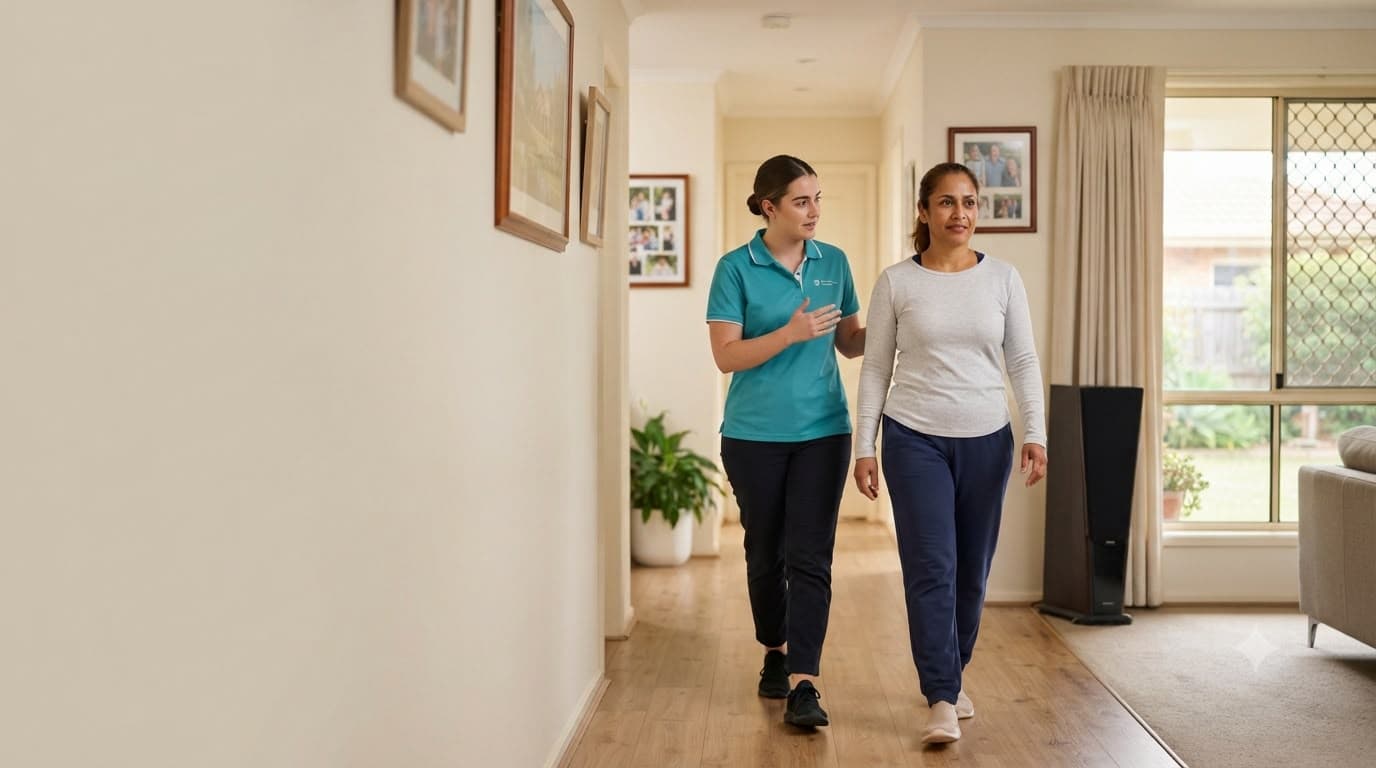
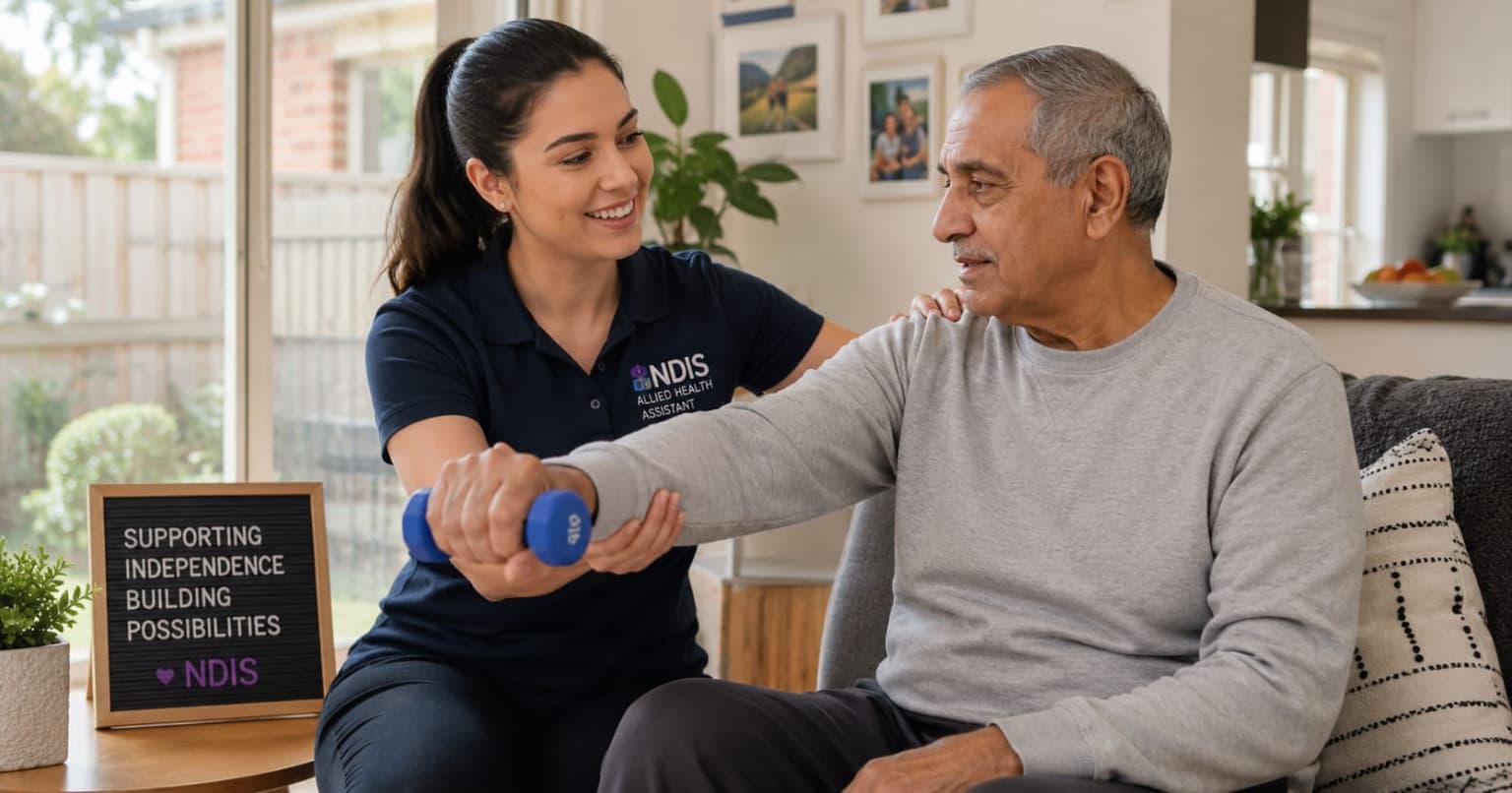
Kind Freedom provided allied health assistant sessions three times per week, with each session running 55 minutes and delivered in Robert's home in Hoppers Crossing, with sessions occasionally moving into the street and local park as his outdoor confidence built.
The programme was designed and clinically supervised by a registered physiotherapist who specialises in neurological conditions. The initial assessment took a full session — covering Robert's gait pattern, freezing triggers, falls history, upper limb function, fatigue profile, and the specific tasks he was most concerned about losing. The physiotherapist developed an individualised programme drawing on principles used in Parkinson's-specific rehabilitation, including large, exaggerated movement patterns to counter the rigidity and smallness that the condition creates, rhythmic auditory cueing to manage freezing episodes, and progressive upper limb exercises targeting the fine motor control Robert needed for his hands.
Kind Freedom's AHA attended every session without exception over the nine months of the programme. She completed detailed session notes after each visit, which went to the supervising physiotherapist for fortnightly review. The physiotherapist adjusted the programme in response to Robert's week-to-week function increasing load after strong periods, recalibrating after weeks where symptoms were heavier. Robert, being Robert, began keeping his own notes alongside the AHA's. He brought them to the fortnightly review sessions on a printed spreadsheet.
The programme also included practical cueing strategies that Robert could use independently: counting rhythmically to himself to restart his gait after a freezing episode, using a marked line on the floor as a visual trigger for doorways, restructuring his daily routine to reduce the transitions that triggered the most freezing. These were not generic strategies from a pamphlet. They were built for his home, his layout, and his particular pattern of symptoms.
NDIS funding used: Category: Capacity Building Improved Daily Living Skills (Category 15) Support item: Therapy Assistant (Level 2) Item code: 15_053_0128_1_3 Price limit (2025–26 standard rate): $86.79/hr Plan type: Self-Managed
Results Achieved
0
Falls in the Past 6 Months
108+
Therapy Sessions Completed
3x
Weekly Park Walks Resumed with Helen
9 months
Function Maintained — Decline Slowed
Robert is clear about something when he talks about the past nine months. He has not improved, in the clinical sense of that word. Parkinson's does not work that way.
What has happened is different, and in its own way more significant: the rate at which he was losing function has slowed. His physiotherapist described it at the six-month review as "maintaining at a level consistent with earlier in his disease progression." Robert, who had by this point produced six months of his own tracking data on the printed spreadsheets, agreed with the assessment. He had reached the same conclusion independently.
The freezing episodes have not disappeared. But they have become more predictable, and more importantly, more manageable. Robert has a strategy that works for him — a specific rhythmic count that he begins the moment his feet start to hesitate — and it works reliably enough that he no longer fears the hallway, the garage doorway, or the transition from carpet to tiles that used to catch him most often.
He has not had a fall in six months. In the year before Kind Freedom, he had two.
His right hand — the one he was most concerned about — has maintained function for the tasks he prioritised. He ate Christmas dinner independently. He signed the paperwork for his car sale himself, with his own signature. He is still in the garage. He has moved from power tools to hand tools, but he is still in there.
Three mornings a week, Robert and Helen walk to the park and back. It is twenty minutes each way, and Robert uses his cueing strategy for the gate, which used to freeze him reliably. It has not frozen him in eleven weeks. They have been doing this walk for the past four months. They had stopped it for two years.
Helen went back to her book club in month five. She goes every month now. She told Kind Freedom's AHA, at the end of a session in which Robert had been in the garage for forty minutes without incident, that she had not felt this level of ease in two years. She used the word "ease" deliberately. She had been thinking about the right word for a while.
Participant Feedback
“Robert's quote: "I spent fifty years fixing things. This is the one thing I can't fix. But I've worked out that keeping it from getting worse is a different kind of job — and it turns out I can do that job. These sessions are part of how I do it." Helen's quote: "He walked into that first appointment with his arms crossed. I walked in terrified. Nine months later, I went to my book club for the first time in two years. That is what the difference looks like from where I am standing."”
— Robert (age 71) and Helen, his wife — Hoppers Crossing, Western Melbourne
For Anyone Living with Parkinson's or Loving Someone Who Is
Parkinson's disease asks something specific of the people it touches. Not the energy of recovery, or the clarity of rehabilitation after an injury but something quieter and harder. The patience to work at something that is not going to be cured. To maintain function that would otherwise decline. To keep doing, as Robert put it, a different kind of job.
That job is real. And structured, consistent therapy support delivered at the frequency the evidence recommends, in the home where life actually happens makes a measurable difference to how long function is maintained and how safely people can continue to live their daily lives.
If you or someone you live with has Parkinson's disease and has NDIS Capacity Building funding under Category 15, allied health assistant sessions through Kind Freedom may be part of what makes that difference. Our AHAs hold a Certificate IV in Allied Health Assistance and work under the clinical supervision of registered physiotherapists across Hoppers Crossing, Werribee, Sunshine, Footscray, and surrounding suburbs in Melbourne's west.
We also understand what the families are carrying. If you are the one managing medication, rearranging your schedule, giving up things quietly so the person you love can be safe the right support structure changes that picture too.
There is no waitlist. No standard package. We work with self-managed and plan-managed participants only.
→ Learn more about our Allied Health Assistant service: kindfreedom.com.au/services/allied-health-assistant/
→ Talk to our team: kindfreedom.com.au/contact/
→ Call us directly: 0405 458 852