


Overview
This guide covers what disability support services are available in Melbourne, five practical ways to find providers, what to look for when comparing them, and how to take your first steps whether you're newly approved, relocating, or looking for a change.
Table of contents
(15 sections)
Table of contents
(15 sections)Getting an NDIS plan approved is a big deal. But for many people, the moment after approval is the most confusing part because suddenly you have funding and a list of goals, and no clear idea of where to actually find the support you need.
Melbourne has a large and varied disability support sector. There are hundreds of providers, dozens of service types, and not nearly enough clear guidance on how to find the right one for your situation. If you've been staring at the NDIS provider finder wondering where to begin, this guide is for you.
We'll walk you through the types of support available, how to find providers, what to look for, and how to get started in plain, straightforward language.
What Disability Support Services Are Available in Melbourne?
Before you start searching, it helps to know what you're looking for. NDIS support in Melbourne falls into several broad categories, each funded differently within your plan.
Support Type | What It Includes | NDIS Funding |
Daily Living Assistance | Help with showering, dressing, meals, household tasks | Core Supports (Category 1) |
Community Participation | Getting out, social activities, life skills in the community | Core Supports (Category 4) |
Allied Health Assistant (AHA) | Therapy programmes under clinician supervision | Capacity Building (Category 15) |
Life Skills & Independence | Cooking, budgeting, travel training, daily routines | Capacity Building (Category 15) |
Personal Care | Low-risk personal hygiene and grooming support | Core Supports (Category 1) |
Transport Assistance | Getting to appointments, work, and community activities | Core Supports (Category 5) |
Support Coordination | Help navigating and setting up your plan | Capacity Building (Category 7) |
Therapy Services | Physiotherapy, OT, speech pathology | Capacity Building (Category 15) |
You don't need to access all of these your plan will only include the supports that were approved based on your goals and needs. Start by looking at what categories your plan includes, then find providers who deliver those specific services.
Registered vs Unregistered Providers
Registered Provider | Unregistered Provider |
Can work with NDIA-managed plans | Usually works with self-managed or plan-managed plans |
Listed in the NDIS Provider Finder | May not appear in the directory |
Registered with the NDIS Commission | Not NDIS registered but may still meet professional standards |
Suitable for all plan types (where applicable) | Suitable for self-managed and plan-managed participants |
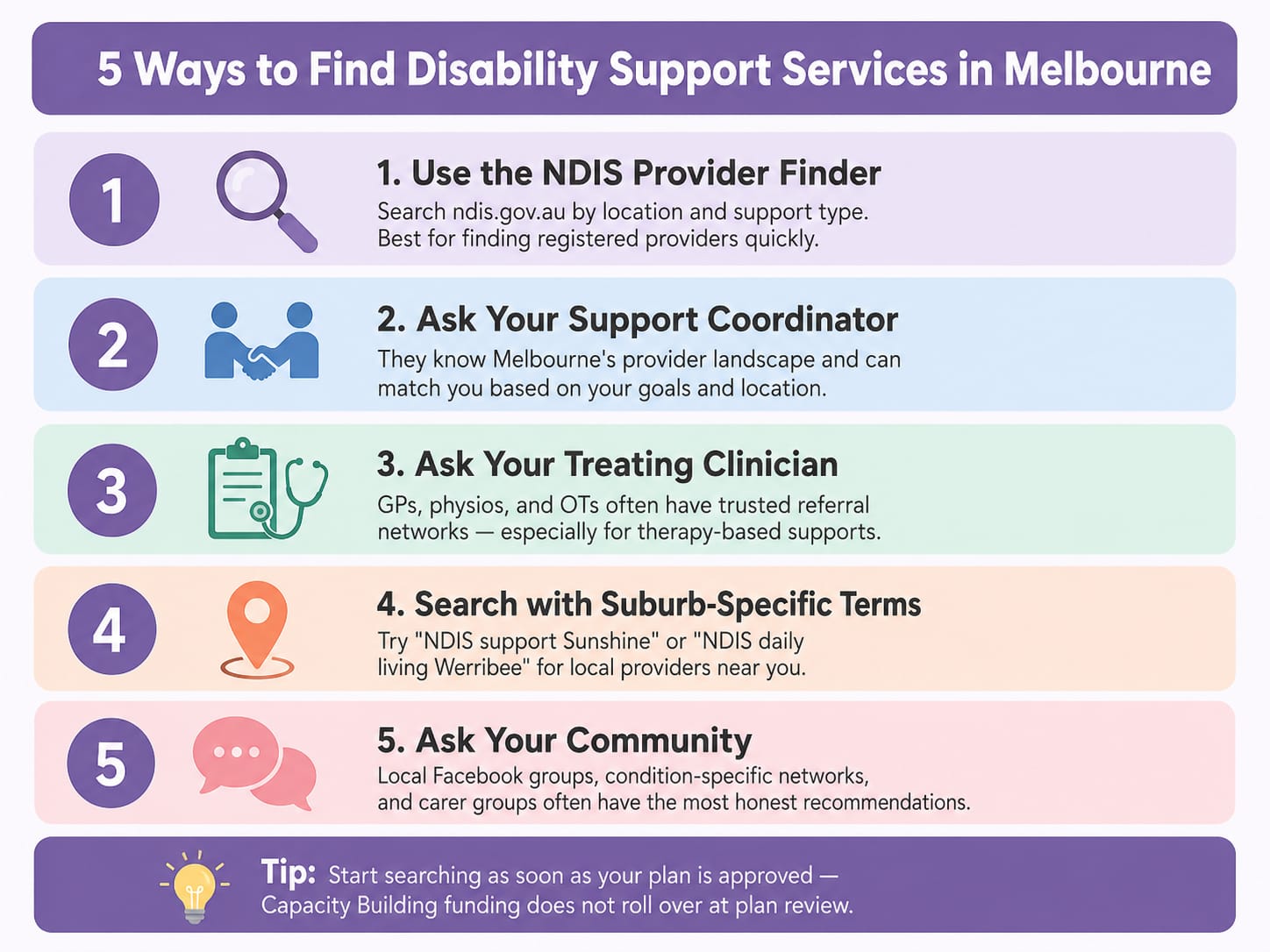
5 Ways to Find Disability Support Services in Melbourne
1. Use the NDIS Provider Finder
The official NDIS website has a provider search tool at ndis.gov.au/participants/working-with-providers/find-provider. You can filter by location, support category, and registration status. It is the most comprehensive directory available, but it only lists registered providers if you are self-managed or plan-managed, there are many quality unregistered providers who will not appear here.
Use the NDIS finder as a starting point, not the only resource.
2. Ask Your Support Coordinator
If your plan includes Support Coordination funding, your support coordinator's job is literally to help you find and connect with the right providers. A good support coordinator will have existing relationships with local Melbourne providers, know which ones have availability, and be able to match you based on your specific needs and location.
If you don't have a support coordinator, your LAC (Local Area Coordinator) can help in a similar way.
3. Ask Your Treating Clinician
Your GP, physiotherapist, occupational therapist, or specialist will often know which NDIS providers work well for your specific condition. This is especially true for allied health assistant services and therapy-based supports clinicians in Melbourne's disability sector tend to have well-established referral networks.
A recommendation from your treating clinician is often the most reliable way to find a provider with genuine experience in your condition area.
4. Search Online with Location-Specific Terms
Search engines are your friend here. Try searches like:
"NDIS allied health assistant Sunshine"
"NDIS support worker Footscray"
"NDIS daily living support Werribee"
"NDIS community participation Melbourne west"
Smaller, local providers who serve specific suburbs often rank well for these kinds of searches and local providers are frequently better placed to offer consistent staffing and faster start times than large national organisations.
5. Ask Within Your Community
Word of mouth remains one of the most reliable ways to find a good provider , particularly within communities where a specific condition or disability is common. Disability advocacy groups, local Facebook groups for NDIS participants and carers, and condition-specific support communities (MS Australia, Parkinson's Victoria, Autism Victoria, etc.) often have firsthand recommendations that no directory can match.
💡 Pro Tip :When you contact a provider for the first time, pay attention to how they respond. Do they ask about your goals and situation , or do they immediately talk about their services and availability? A provider who listens first is worth more than one with a polished website and a slow reply.
Registered vs Unregistered Providers Does It Matter in Melbourne?
This is a question many Melbourne participants have and the answer depends on your plan type.
If your plan is NDIA-managed: You can only use registered providers. The NDIS finder is your main tool.
If your plan is self-managed or plan-managed: You can choose both registered and unregistered providers. In Melbourne especially, some of the most responsive and specialist disability support services operate as unregistered providers particularly in allied health, life skills, and community participation.
Unregistered does not mean unqualified. A good unregistered provider will still hold the appropriate qualifications, carry insurance, and have their workers NDIS-screened. The difference is in the administrative pathway, not the quality of care. See →What Is an Unregistered NDIS Provider?
How Do You Know if a Provider Is the Right Fit?
Finding a provider is only the beginning. The more important question is whether they're the right fit for your needs and goals.
As you compare providers, ask yourself:
Did they take time to understand my goals?
Were they easy to communicate with?
Did they explain things clearly?
Do they offer the support included in my NDIS plan?
Do I feel comfortable asking questions?
A provider should make you feel listened to, not rushed. If something doesn't feel right after your first conversation, it's okay to keep looking. Choosing a provider you trust can make a real difference to your NDIS experience.
Quick Checklist Before Contacting a Provider
Before making your first phone call or sending an enquiry, make sure you have:
✅ Your NDIS plan available
✅ Your support goals in mind
✅ A list of the supports you're looking for
✅ Questions you'd like to ask
✅ Your preferred start date
What to Look For in a Melbourne Disability Support Provider
Finding a provider is one thing. Finding the right provider takes a bit more thought. Here are the things that actually matter:
Consistent staffing. Will you see the same person each week? For both therapy and daily living support, consistency is everything. A provider who rotates workers regularly will cost you more in adjustment time than they save you in availability.
Local knowledge. A provider based in or familiar with Melbourne's western suburbs Sunshine, Footscray, Werribee, Hoppers Crossing, Tarneit will understand local community resources, transport options, and cultural context in ways that a national provider with a local office may not.
Experience with your condition. Ask directly whether they have worked with participants with your condition before. A provider who supports stroke survivors is not automatically well-suited to supporting someone with autism and vice versa.
Clear communication. How responsive are they from the first call? Do they explain things clearly? Do they follow up? The way a provider communicates before you sign an agreement is a good preview of how they'll communicate after.
No long waitlists. This one matters more than people think. A provider who cannot start for three months may be excellent but if you have Capacity Building funding running down mid-plan, timeliness is part of the quality equation.
Disability Support in Melbourne's Western Suburbs
Melbourne's western suburbs including Sunshine, Footscray, St Albans, Werribee, Hoppers Crossing, Tarneit, Laverton, and Altona are home to one of the most diverse communities in Australia. Finding disability support that genuinely fits means finding a provider who understands that context.
A few things worth knowing about the western suburbs specifically:
Transport access varies significantly. Some areas like Footscray have strong public transport links; others like parts of Werribee and Hoppers Crossing are more car-dependent. If transport is part of your support plan, confirm how your provider handles it.
Cultural and linguistic diversity matters. A meaningful portion of NDIS participants in Melbourne's west come from communities where English is not the first language. If you or your family member would benefit from a provider with multilingual capability or cultural awareness, ask about this directly.
Smaller, local providers often serve this area better. Large national NDIS organisations tend to concentrate their staffing in inner Melbourne. Western suburbs participants often get better consistency and faster start times from providers who specifically operate in this region.
How to Get Started Once You've Found a Provider
Once you have identified one or two providers worth contacting, the process is straightforward:
Step 1 — Make contact. Call or email and briefly explain your situation: your support type, your location, your plan management type, and roughly when you need to start.
Step 2 — Have an initial conversation. A good provider will ask questions about your goals and needs before discussing services. This is not just a courtesy — it determines whether they are actually the right fit.
Step 3 — Request a service agreement. Ask for the agreement in writing before you commit. Check the exit terms, notice period, and exactly what is included.
Step 4 — Confirm your plan type compatibility. If you are plan-managed or self-managed, confirm the provider can work with your management type. If you are NDIA-managed, confirm the provider is registered.
Step 5 — Start. Once the service agreement is signed, your provider will arrange an initial assessment or intake appointment, and your support can begin.
Don't wait until your plan is about to expire before looking for providers. Capacity Building funding in particular does not roll over if you don't use it in your plan year, it is gone. Start looking for providers as soon as your plan is approved, even if you are still working out the details.
Finding the Right Disability Support Starts with the Right Provider
Finding the right disability support in Melbourne takes a bit of time but it is absolutely worth doing well. The right provider makes a real difference to what you get out of your NDIS plan, how consistently your goals are worked toward, and how much energy you and your family spend managing the process.
Start with your goals, be clear about what you need, ask the right questions, and don't settle for a provider just because they responded first.
Kind Freedom provides disability support services across Melbourne's western suburbs including allied health assistant sessions, daily living assistance, life skills and independence, community participation, personal care, and transport assistance. We work with self-managed and plan-managed NDIS participants.
→ Explore our services: kindfreedom.com.au/services → Get in touch: kindfreedom.com.au/contact → Call us: 0405 458 852
Written by
Edson Rushenya
Kind Freedom Australia blogger.