



Overview
This guide explains what NDIS plan management is, what a plan manager does day-to-day, and just as importantly what they don't do. You'll find a clear comparison between plan managers and support coordinators, the answer to whether plan management costs you anything extra, and practical guidance on how to get it and what to look for in a good one.
Table of contents
(19 sections)
Table of contents
(19 sections)Ask ten plan-managed NDIS participants what their plan manager does, and you'll get ten different answers. Some will say "they pay my invoices." Some will say "they sort out my funding." A surprising number will admit they're not entirely sure they were told at their planning meeting that plan management was a good idea, and they went with it.
That confusion is not the participants' fault. Most of the information available about plan management is written from an administrative or compliance angle. It explains the system. It rarely explains what actually happens, what a plan manager does on a Tuesday afternoon, why they exist, and what they cannot do regardless of how good they are.
This article covers all of it.
Quick Answer
If you only remember one thing about plan management, remember this:
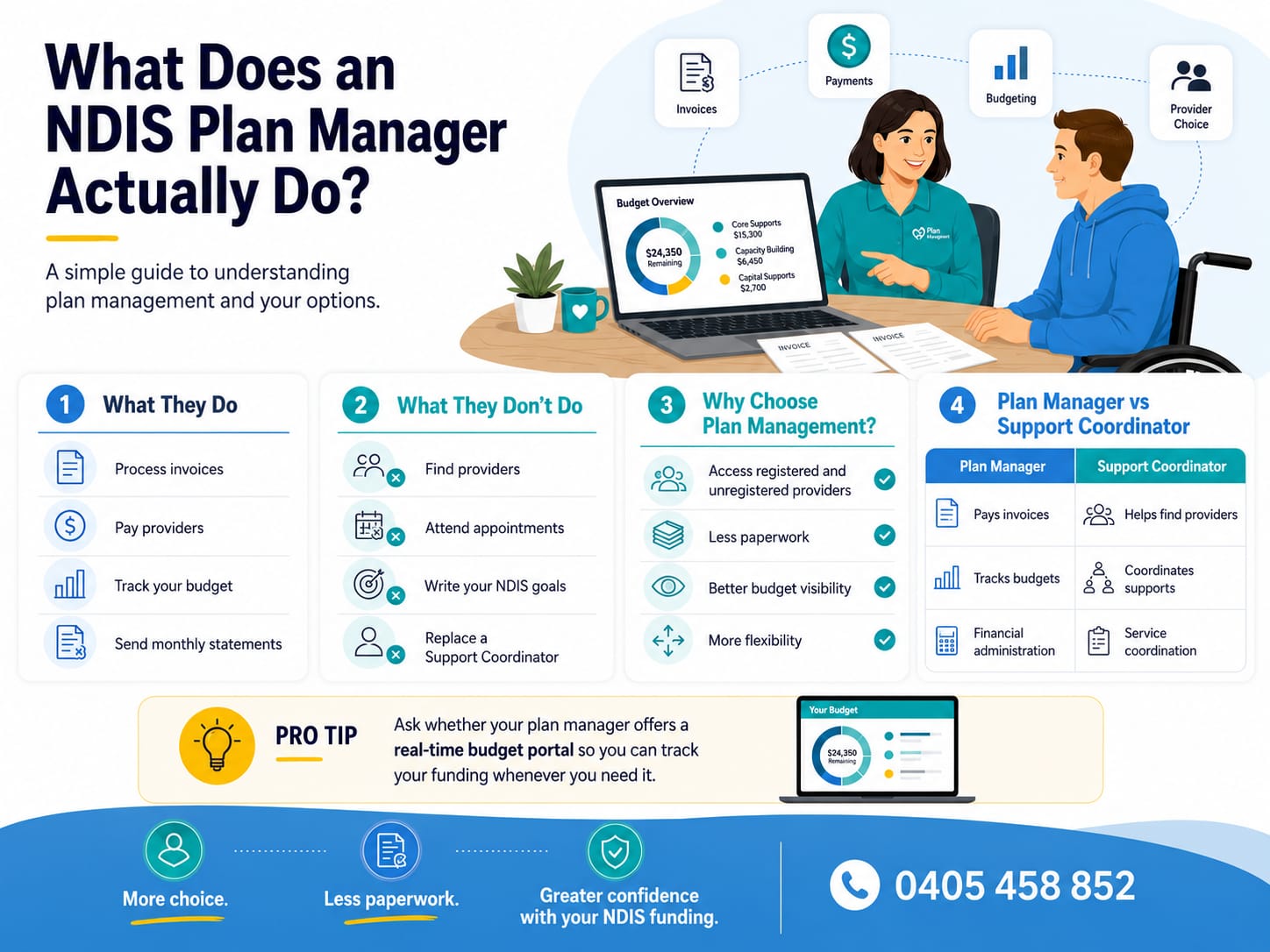
An NDIS plan manager looks after the financial side of your NDIS plan. They pay your providers, keep track of your funding, and provide regular budget updates so you know how your funding is being used.
Unlike an NDIA-managed plan, plan management also allows you to use both registered and unregistered NDIS providers, giving you greater flexibility when choosing the supports that suit your needs.
The best part is that plan management is funded separately by the NDIS, so it doesn't reduce the funding available for your approved support.
The Three Ways to Manage Your NDIS Plan
Every NDIS plan is managed in one of three ways. Understanding where plan management sits is the foundation for understanding what it does.
Management Type | Who Pays Providers | Provider Choice | Admin on You |
NDIA-Managed | The NDIA pays providers directly | Registered providers only | Minimal |
Plan-Managed | A plan manager pays providers on your behalf | Registered AND unregistered providers | Low |
Self-Managed | You pay providers and claim reimbursement | Any provider | High |
Plan management sits in the middle you get broader provider choice than NDIA-managed without taking on the full financial administration of self-management. A plan manager handles the money side so you don't have to.
What Is a Plan Manager?
A plan manager is a registered NDIS provider whose job is to handle the financial administration of your NDIS plan. They receive invoices from your support providers, check that they are correct and within your funding limits, and pay them on your behalf. They keep records of your spending and provide you with regular statements so you can see where your funding is going.
That is their function. They are, at their core, a financial intermediary sitting between your providers and your NDIS budget.
💡 Pro Tip When you first contact a plan manager, ask how you'll be able to see your spending in real time. Good plan managers provide an online portal or app where you can check your remaining budget at any time. If a plan manager can only tell you your balance by email request or monthly statement, that's a limitation worth knowing before you sign up.
At a Glance: What a Plan Manager Can and Can't Do
Understanding the difference between what a plan manager does and doesn't
do can help you choose the right supports and avoid confusion later.
A Plan Manager Can... | A Plan Manager Can't... |
Pay provider invoices | Find service providers for you |
Keep track of your NDIS budget | Attend your appointments |
Process claims and payments | Develop your NDIS goals |
Provide spending reports | Coordinate your supports |
Help with invoice enquiries | Replace a Support Coordinator |
While plan managers play an important role in managing your funding, they're only one part of your support network. If you also receive Support Coordination, the two roles work together but have different responsibilities.
What Does a Plan Manager Actually Do?
Here is what actually happens behind the scenes when you are plan-managed:
When your provider submits an invoice: Your support provider sends the invoice to your plan manager not to you. The plan manager checks that the service matches what was agreed in your service agreement, that the price is within the NDIS price limits, and that you have sufficient funding in the relevant budget category. If everything is in order, they pay the provider within the required timeframe (currently five business days under NDIS rules).
Ongoing budget tracking:
Your plan manager keeps a running record of every payment made against each of your funding categories. This is important because NDIS plans have separate budget lines your Core Supports, Capacity Building, and Capital Supports budgets are tracked separately, and overspending one category cannot be covered by another.
Statements and reporting:
Most plan managers provide monthly statements showing what has been spent, what remains, and a breakdown by support category. This helps you and your support coordinator see whether you are on track to use your funding appropriately across the plan year.
Provider queries:
If a provider invoices incorrectly wrong item code, wrong rate, duplicate charge your plan manager is the one who queries it and requests a correction. This saves you from having to manage billing disputes directly.
What a Plan Manager Doesn't Do
This is the section that most articles skip and it is arguably the most useful part of this guide.
A plan manager does not:
Find providers for you. Sourcing, vetting, and engaging your support providers is your responsibility , or your support coordinator's. Your plan manager has no role in this.
Attend your appointments or sessions. They have no visibility into the support you receive. They only see the invoices.
Set your goals or design your support plan. That is the NDIS planner's or LAC's role, ideally informed by your clinicians and support coordinator.
Make decisions about your support. If a provider is not working for you, a plan manager cannot change that. They pay invoices , they do not manage relationships.
Advocate for you in plan reviews. They can provide spending reports that support your review, but active advocacy is a support coordinator's role.
Contact your providers proactively. A plan manager responds to invoices. They do not proactively check in with your support team or flag issues with your programme.
Understanding these boundaries matters because participants who expect their plan manager to do these things end up frustrated , not because their plan manager is bad, but because those tasks belong to someone else entirely.
Plan Manager vs Support Coordinator — What's the Difference?
This is the most common point of confusion in NDIS plan management, and almost no competitor content addresses it clearly.
Plan Manager | Support Coordinator | |
Primary role | Financial administration | Connecting you with supports and services |
Pays invoices | Yes | No |
Helps find providers | No | Yes |
Attends meetings / reviews | Rarely | Often |
Monitors your support quality | No | Yes |
Funded from | Separate plan management budget | Capacity Building — Support Coordination |
NDIS registration required | Yes | Yes (for registered coordinators) |
Contact with your providers | Invoice-related queries only | Regular coordination and communication |
Think of it this way: your support coordinator manages relationships. Your plan manager manages money. Both roles are important, and in a well-functioning plan, they work alongside each other but they are not interchangeable, and one cannot do the other's job.
Does Plan Management Cost You Anything Extra?
No, and this is one of the most important things to understand about plan management.
Plan management is funded separately within your NDIS plan. The NDIS includes a specific budget allocation to pay your plan manager's fees. This funding is in addition to your disability support budgets , it does not come out of your Core Supports or Capacity Building funding.
In practical terms: choosing plan management does not reduce the amount you have available to spend on your actual support. You get the full support budget the NDIS approved, plus a separate amount to cover plan management fees.
At your planning meeting, specifically ask for plan management to be included and confirm that the plan management budget is separate from your support funding. Some participants have incorrectly been told that plan management reduces their support budget this is not correct under NDIS guidelines.
Why Plan Management Gives You More Choice
When your plan is NDIA-managed, you can only access registered NDIS providers. Registration requires providers to undergo formal audits and meet specific practice standards , which limits the pool significantly, particularly for specialist or local providers.
When your plan is plan-managed, you can access both registered and unregistered providers. An unregistered provider may be a specialist allied health team, a smaller local support service, or a provider who has chosen not to go through the registration process but holds full qualifications and insurance.
For participants in Melbourne's western suburbs particularly, this is significant many of the most responsive, specialist, and locally-grounded providers in areas like Sunshine, Footscray, Werribee, and Hoppers Crossing operate as unregistered services. Plan management is what makes them accessible to you.
How to Get Plan Management — or Switch to It
At your planning meeting or plan review: Simply request plan management during the meeting. Tell your planner or LAC that you would like your plan to include plan management funding. Bring it up early in the conversation , not at the end. The planner will include a plan management budget line and you choose your plan manager after the plan is approved.
Mid-plan (without waiting for a review):
You do not always have to wait for your next plan review. If your circumstances have changed, or if you were not offered plan management at your last meeting, you can request a plan reassessment or a mid-plan change. Speak with your LAC or support coordinator about the most appropriate pathway.
Choosing your plan manager:
Once your plan includes plan management funding, you select your own plan manager. Things to look for:
A real-time portal or app where you can check your budget yourself
Clear response times for invoice processing (five business days is the NDIS standard)
A dedicated contact person , not a generic inbox
Experience with your support types (particularly if you have complex or multi-category funding)
Warning Signs Your Plan Manager Is Not Doing Their Job
This section does not exist in any competitor article , but it should.
Consider reviewing your plan manager if:
Your providers regularly chase you for payment because invoices are not being processed on time
You cannot get a clear picture of your remaining budget when you need it
Monthly statements arrive late, are inconsistent, or are difficult to understand
Invoicing errors are frequent and not caught before payment
You are approaching the end of your plan year with either significant underspend or unexpected overspend that was not flagged earlier
You have the right to change plan managers. The process involves notifying your current plan manager (notice periods apply — check your service agreement) and engaging a new one. Your funding does not change.
Who Benefits Most from Plan Management?
Plan management can be a good option for many participants, particularly those who want more flexibility without taking on the paperwork involved in self-managing their plan.
It may be especially suitable if you:
I want access to both registered and unregistered NDIS providers.
Don't want to manage invoices or payment claims yourself.
Use several providers and would like someone to handle the financial administration.
Prefer regular budget updates throughout your plan.
Want greater provider choice while keeping the administrative side simple.
Every participant's situation is different, so the best management option depends on your goals, confidence with administration, and the level of flexibility you're looking for.
Common Misunderstandings About Plan Management
Many people hear the term plan management and assume it means someone manages their entire NDIS plan. In reality, that's not how it works.
Here are a few common misconceptions:
A plan manager doesn't choose your providers for you.
A plan manager doesn't replace a Support Coordinator.
Plan management doesn't reduce your support funding.
You still make the decisions about your supports and providers.
Choosing plan management gives you more provider options, not less.
Understanding these differences can help you choose the right management option and know exactly what support to expect.
Key Takeaways Before You Choose Plan Management
Plan management is one of the more practical and participant-friendly options the NDIS offers. It gives you flexibility, provider choice, and financial administration without placing the full burden of NDIS bookkeeping on you or your family.
But it works best when you understand what it covers , and what it does not. A plan manager who processes your invoices efficiently is doing exactly their job. Everything else , finding the right providers, coordinating your support, advocating at your review , is a different conversation, with different people.
If your plan is currently NDIA-managed and you would like access to a wider range of providers in Melbourne's west, switching to plan management is worth discussing at your next planning conversation.
Kind Freedom is an unregistered NDIS provider working with plan-managed and self-managed participants across Sunshine, Footscray, Werribee, Hoppers Crossing, and surrounding suburbs. We provide allied health assistant sessions, daily living support, life skills and independence, community participation, personal care, and transport assistance.
→ Our services: kindfreedom.com.au/services → Talk to our team: kindfreedom.com.au/contact → Call us: 0405 458 852
Written by
Edson Rushenya
Kind Freedom Australia blogger.