

Liam had autism, sensory sensitivities, and no peer connections. His mum Amara was doing everything alone. Kind Freedom's NDIS support changed both of their lives.
Overview
Participant
Liam
Teen (13–17)
Location
Sunshine, Western Melbourne
Support duration
12 months (ongoing)
Support needs
The Challenge
Background
Liam was four years old when he was diagnosed with autism spectrum disorder. He is nine now, and for most of those five years, his mother Amara has been the only person in his corner.
She moved to Melbourne from East Africa before Liam was born, and she has raised him alone, in a language that is not her first, in a system that was not built with her in mind. She works part-time as a hospital cleaner, finishing early shifts so she can collect Liam from school. She has no family nearby. She has had very little help.
Liam is a bright, curious boy who loves trains and can tell you the departure times of every route on the Sunshine line from memory. He also finds transitions between activities deeply difficult, has significant sensory sensitivities, particularly to noise and unexpected physical contact, and has almost no peer connection. His school had flagged concerns about his social isolation. He ate lunch alone, most days.
The thing that stayed with Amara most, in the months before she found Kind Freedom, was a birthday party. Liam had been invited to a classmate's party, one of the few invitations he had ever received. The noise and the unpredictability overwhelmed him within twenty minutes. He became distressed. Amara had to take him home early. He was not invited again. After that, she stopped trying.
Liam had been on the NDIS for two years with a self-managed plan that included Core Supports funding for community participation and daily living. Amara had found the system confusing and had not used all of his funding. A new support coordinator helped her understand what was available and referred her to Kind Freedom. Sessions began four weeks later.
Goals
Amara and Liam's support coordinator identified three goals for his Kind Freedom support:
- Build Liam's capacity to manage his morning routine, dressing, breakfast, packing his school bag, with less dependence on Amara's direct involvement
- Support Liam to participate in at least one regular community activity alongside other children
- Reduce Liam's anxiety around transitions between activities and unfamiliar environments. There was an unspoken fourth goal that Amara mentioned quietly when she first met the Kind Freedom team. She wanted three hours a week that were just hers. Not for anything in particular. Just hers.
Challenges
Before anything else could happen, Kind Freedom's support worker had to earn Liam's trust. That took time.
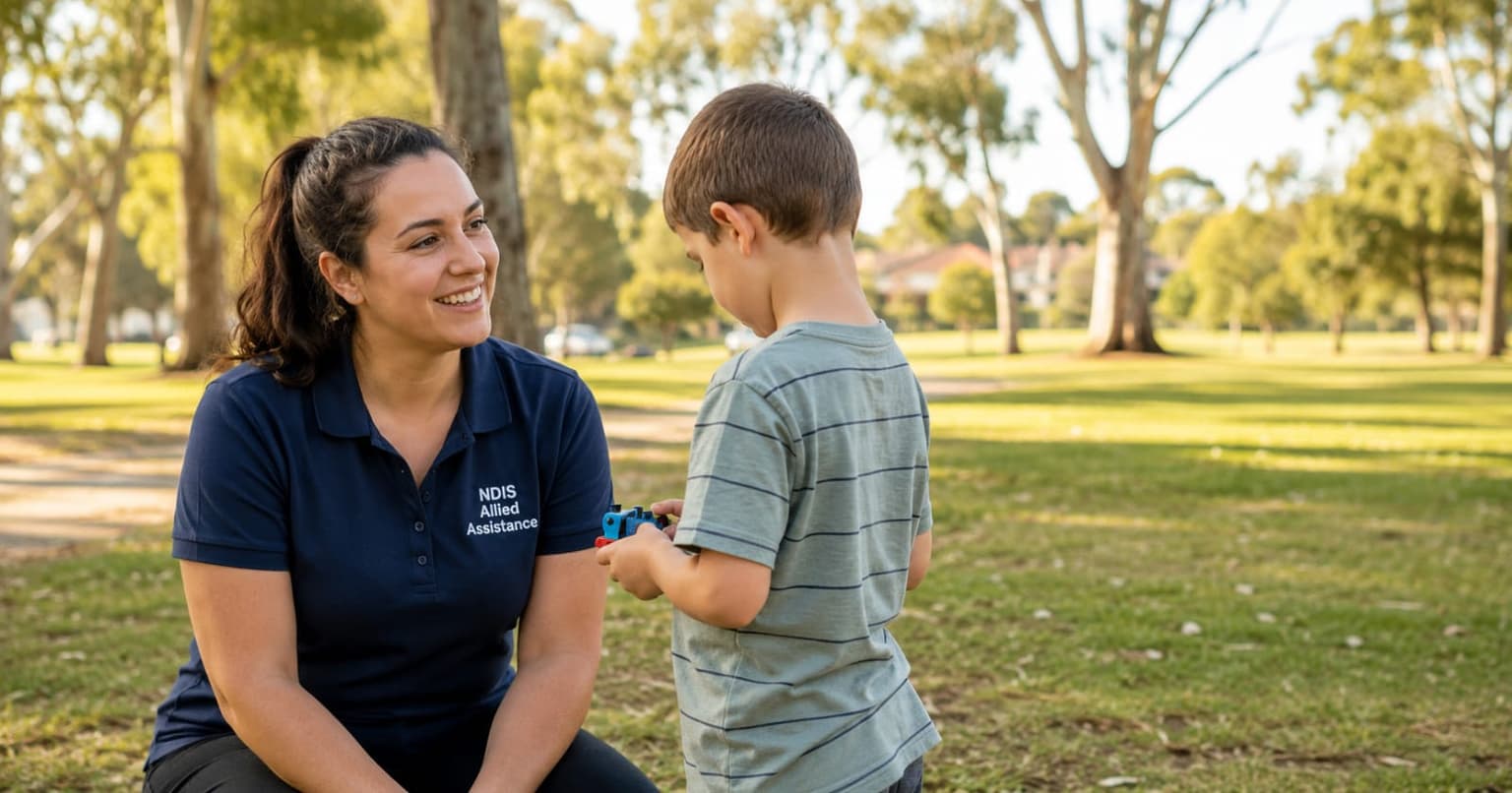
For the first four weeks, Liam would not engage directly. He would allow the support worker to be in the house at a careful distance while he played with his train set. She did not push. She learned his rhythms. She learned that he needed five minutes of warning before any transition, that he preferred requests framed as choices, that the television volume had to be below a certain level for him to remain regulated. She showed up every session and did the same things in the same order, and she waited.
In week five, Liam handed her a train carriage and told her its number. That was the beginning.
Three things had made the period before Kind Freedom particularly hard. The first was isolation Liam's and Amara's both. Liam had no peer connection worth speaking of, and Amara had spent nine years being the only person who understood how to support him. She was exhausted in the way that only sustained, invisible effort can make you exhausted.
The second was the NDIS itself. Amara had not fully understood what Liam's funding covered or how to use it. She had let support hours go unused because she did not know how to find providers who would show up consistently and actually know what they were doing. She had tried one provider before Kind Freedom. The support worker changed three times in two months. Liam could not adapt. They stopped.
The third was Amara's fear of trying again. After the birthday party, after the previous provider, after years of explaining her son's needs from scratch to every new person she was cautious about trusting anyone new with him. The referral to Kind Freedom came with a specific recommendation. She took a chance.
How We Helped
Kind Freedom provided community participation and life skills support twice a week one 90-minute session focused on daily living and routine building at home, and one 90-minute session in the community.
The home sessions worked on Liam's morning routine. His support worker used a visual schedule a laminated card with pictures of each step from waking up to walking out the door developed in consultation with his occupational therapist at school. The goal was not to change what Liam did, but to reduce how much prompting he needed from Amara to do it. Over weeks of consistent practice, each step of the routine was gradually handed back to him.
The community sessions were centred on a weekly soccer skills group at a local club in Sunshine that runs an autism-friendly programme with smaller groups, quieter environments, and coaches trained in neurodiversity. Getting Liam through the gate on the first day took the full 90 minutes. By week six, he walked in ahead of his support worker.
Throughout both session types, Kind Freedom's support worker maintained detailed session notes, communicated regularly with Amara about what was working and what needed adjusting, and aligned her approach with what Liam's school occupational therapist was already doing. The consistency of the language and strategies used between school, home, and community was deliberate.
NDIS funding used: Category: Core Supports Assistance with Social, Economic and Community Participation (Category 4) and Core Supports Assistance with Daily Life (Category 1) Support type: Support Worker Plan type: Self-Managed
Results Achieved
31
Soccer Sessions Attended
12 months
Consistent Support Without Disruption
1
First Peer Friendship Formed
6 hrs
Weekly Time Returned to Amara
Twelve months in, Liam packs his own school bag every morning. He has done it without prompting for the past three months. Amara used to spend twenty minutes every morning managing that process alongside everything else. She does not do that anymore.
He has attended thirty-one soccer sessions. He started by standing at the edge of the group, watching. By month four, he was participating in the drills. By month eight, he was arriving early.
At soccer, he met another boy. They do not talk much they stand side by side and pass the ball back and forth before the session starts. But they look for each other when they arrive. Amara calls him Liam's first friend. She says it quietly, like she is still getting used to it being true.
His class teacher sent Amara a message in term three. Liam had sat with two other children at lunch on three separate occasions. She thought Amara would want to know.
For Amara, the change has been as much about her own life as Liam's. She now has six hours a week during which someone else is with her son, someone who knows him, someone she trusts. She has used some of that time to sleep. She has used some of it to sit in a cafe without watching the clock. She said that felt like something she had forgotten was allowed.
The moment she describes most often is from early in the programme. Liam's support worker was leaving at the end of a session. Liam, without being prompted, turned from his train set and waved.
"He has never waved at anyone before," Amara said. "That was when I knew."
Participant Feedback
“Liam's quote: "She knows I don't like loud. She never makes it loud." Amara's quote: "I moved here alone. I have done everything for Liam alone, for nine years. When Kind Freedom came, it was the first time someone showed up who already understood. I did not have to explain from the beginning. They understood, and they kept coming back."”
— Liam (age 9) and Amara, his mother — Sunshine, Western Melbourne
If You're Reading This as a Parent
You already know how much work this is. You do not need anyone to tell you that. What you might need is to know that the right support consistent, understanding, and willing to earn your child's trust before asking anything of them does exist.
Many parents who contact Kind Freedom have tried other providers before us. Some have had support workers who changed every few weeks. Some have spent months explaining their child's needs from scratch, over and over. Some have given up on community participation because the distress it caused outweighed anything that came from it.
We do not promise dramatic transformations. What we can offer is consistency, genuine understanding of how autistic children experience the world, and support that aligns with what your child's therapy team is already doing rather than working against it.
Kind Freedom provides community participation and life skills support for children and adults with autism across Sunshine, Footscray, Werribee, Hoppers Crossing, and surrounding suburbs. We work with self-managed and plan-managed NDIS participants. We are an unregistered provider, which means we cannot support NDIA-managed plans but if your plan is self-managed or plan-managed, we would be glad to have a conversation.
There are no waitlists. No packages. Just an honest discussion about whether we are the right fit for your child.
→ Learn more about Community Participation support: kindfreedom.com.au/services/community-participation/
→ Learn more about Life Skills and Independence support
kindfreedom.com.au/services/life-skills-independence/:
→ Talk to our team: kindfreedom.com.au/contact/
→ Call us directly: 0405 458 852